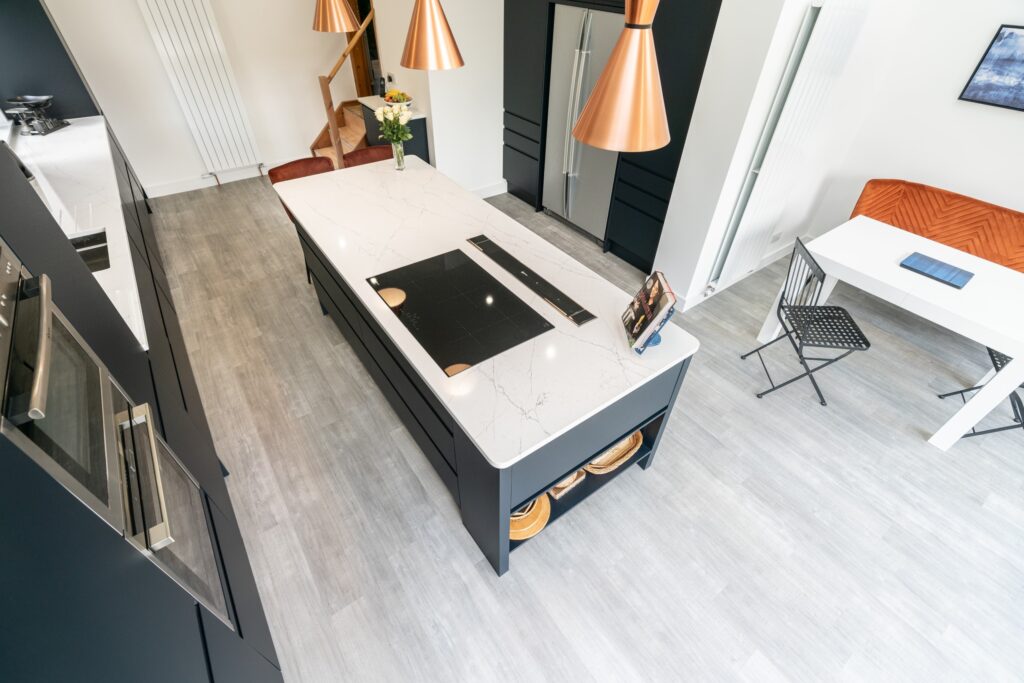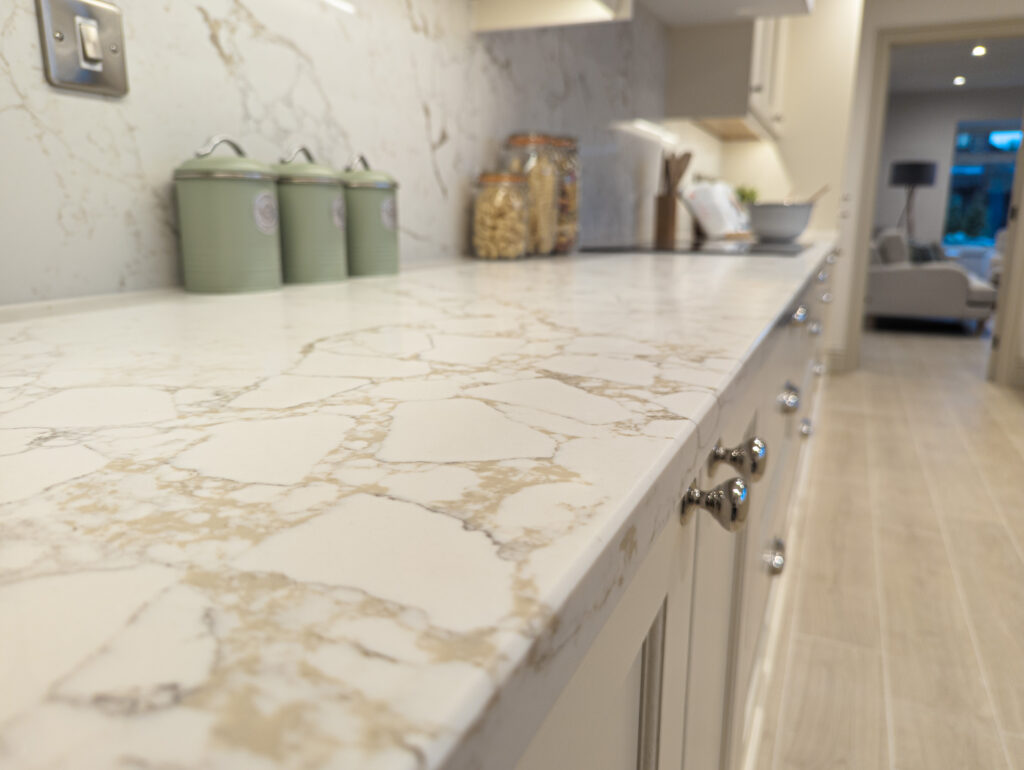
A quartz worktop is a long-term investment, and the ones we fabricated ten years ago are still in place today, performing as they should. That longevity is one of the main reasons homeowners choose quartz in the first place.
However, that same longevity raises a question worth careful consideration, as kitchen technology evolves quickly. Wireless charging, invisible induction, downdraft extraction, pop-up sockets and smart lighting have all gone from niche to mainstream in a few years. If your worktop is going to be in place for a decade or more, some of what feels optional today may feel essential tomorrow.
The good news is, you do not need to install every piece of technology now to benefit from it later. Instead, make a handful of decisions at the fabrication stage that keep your options open. We have plenty of these conversations week in, week out, and this is what we advise.
Why Planning Matters With Quartz
Once a quartz worktop is fabricated, cut and installed, it is fixed. The slab has been templated to the kitchen, machined to your specifications, and bonded into place. Changing it afterwards is not impossible, but it is difficult, disruptive and expensive.
Adding a cutout to an installed worktop means cutting into stone already bonded to your cabinets, with no way to control dust or properly protect the surrounding surfaces. Routing the underside for a wireless charger after installation is even harder because the underside is no longer accessible. In most cases, retrofitting technology to an existing worktop means removing the slab entirely, which usually means replacing it.
The cost difference between planning and retrofitting later can be enormous, which is why it’s important to prepare your worktop for future technology, even if your budget or plans do not stretch to installing everything immediately.

Get the Thickness Right
The thickness has to be right for the technology you plan to put in your kitchen in the future.
Quartz is most commonly available in 20mm and 30mm thicknesses. The visual difference is subtle but noticeable. A 30mm worktop has a more substantial, solid presence, particularly on an island, showing its thick exposed edge. A 20mm worktop feels lighter and more contemporary, and it suits minimalist kitchen designs where slim profiles are part of the aesthetic.
From a technology perspective, however, the decision matters for entirely different reasons.
Most wireless charging systems perform best when the transmission distance through the stone is 12mm or less. A 20mm quartz slab can be routed on the underside to create a shallow recess, reducing the thickness in that specific area to around 12mm, allowing the charger to sit close enough to the surface to work properly. If you decide on a 30mm slab, it requires deeper routing to achieve the same result, which removes more material and requires more careful assessment of structural integrity.
For invisible induction systems, thinner surfaces transmit electromagnetic energy more efficiently. While quartz is not the ideal material for invisible induction due to its resin content, if you are considering it as a possibility, thickness becomes even more important.
Our advice to you is, if you are drawn to the substantial look of 30mm quartz and you are confident you will never want under-worktop technology, go for it. If there is a chance you might want wireless charging or similar systems in the future, 20mm gives you significantly more flexibility with far less fabrication complexity.
Think About Your Cutouts Before You Commit
If you are having a cutout in your quartz worktop, it must be made during fabrication, before the slab is installed. This includes hob cutouts, sink cutouts, pop-up socket openings and any cutout required for a downdraft extractor.
If you know you want a pop-up socket on your island, and you are not ready to buy the unit yet, choose the model and position now. You can cut the opening during fabrication, and you can simply fit a blanking plate or a temporary cover until you are ready to install the socket itself.
The same principle applies to downdraft extractors. If a downdraft system is something you might want to add in the future, the worktop depth needs to accommodate it now. Adding extra depth to a worktop later is not a modification; it is a replacement.
Furthermore, cutout positions interact with each other. A pop-up socket too close to a hob cutout leaves insufficient stone between the two openings, which weakens the slab. An extractor cutout that sits too close to the edge of the worktop creates a structural risk. These are the calculations we make during templating, and the more we know about your future intentions, the better we can plan for the layout.

Prepare the Cabinets, Not Just the Stone
This is the point that homeowners most frequently overlook, and yet it costs almost nothing to get right.
Most kitchen technology that integrates with a worktop needs power beneath it. Wireless chargers need a mains connection in the cabinet below. Pop-up sockets need to be wired in. Downdraft extractors need power and either ducting to an external wall or space for recirculation filters. Invisible induction requires a dedicated high-power circuit.
Even if you are not installing any of these systems at this time, running a spare power supply into the relevant cabinets during your kitchen build costs very little. Adding a socket to a base unit while the kitchen is being fitted is a five-minute job. An electrician doing the same thing three years later, after your kitchen is finished, decorated and lived in, is a considerably more involved and disruptive undertaking.
Understand What Quartz Can and Cannot Accommodate
Being realistic about the material is part of future-proofing too.
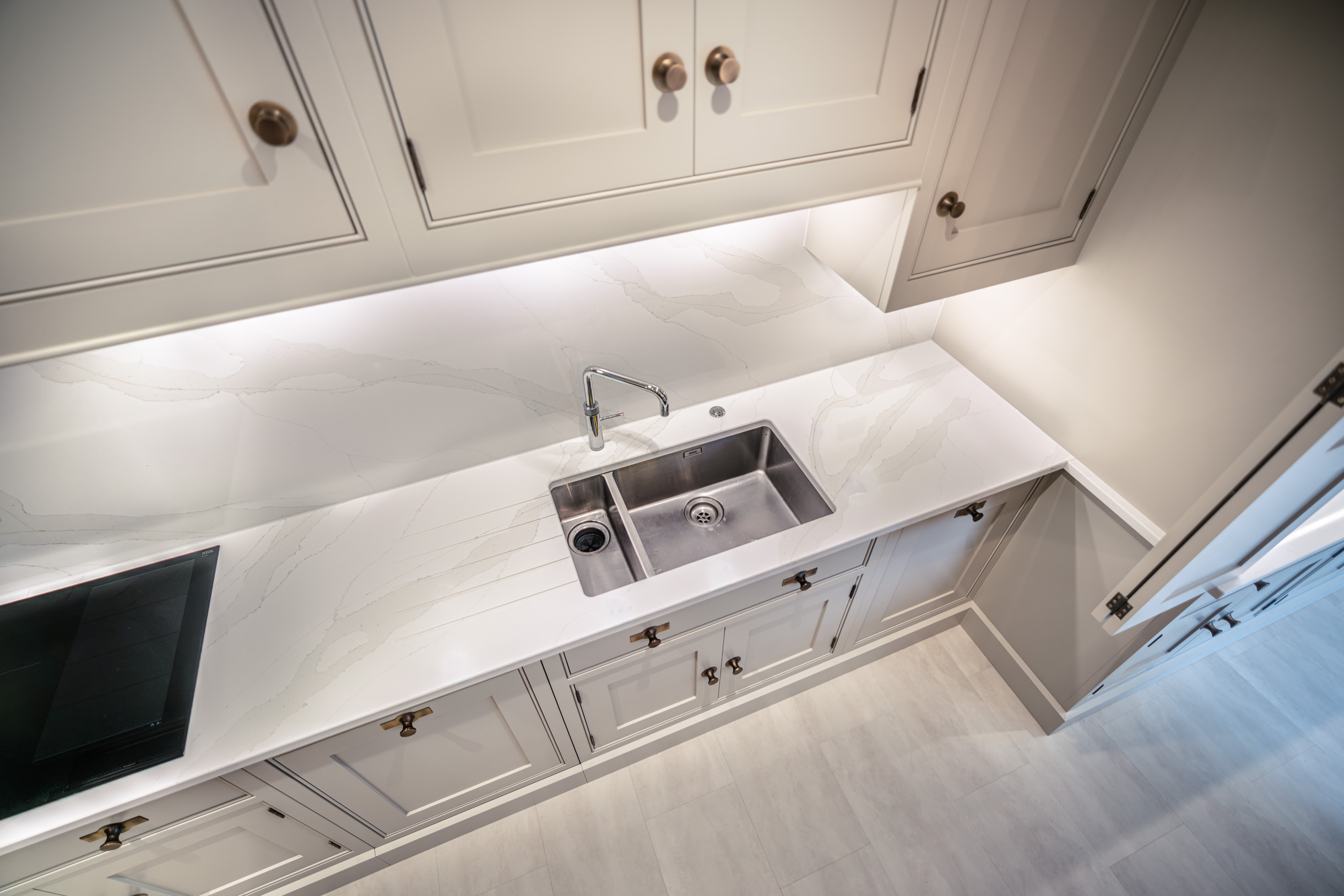
Quartz surfaces handle most integrated kitchen technology extremely well, including wireless charging, pop-up sockets, flush-fit hobs, undermount sinks, integrated drainage grooves and downdraft extractors.
The one area where quartz has a genuine limitation is sustained high heat. The polymer resins that bind the quartz together can be affected by prolonged exposure to temperatures above roughly 150°C. In everyday use, with trivets for hot pans, this is not an issue. For invisible induction systems like InvisaCook, where the worktop itself becomes the cooking surface and residual heat transfers back into the stone during extended cooking, it is a factor that needs careful consideration.
Therefore, if invisible induction is something you are considering now or in the near future, sintered stone such as Dekton or Neolith is the more appropriate material choice. It isn’t because quartz isn’t up to the job; it’s that sintered stone is better suited to that specific application, and it is worth knowing that before you commit rather than after.
The Five-Year Test
When we advise our customers, we often suggest thinking about your kitchen five years from now. Is your household going to change? Will more devices need charging? Will you be cooking differently? Might you want to open up the space, add an island, or change how the kitchen connects to the rest of the house?
You do not need certain answers. You just need to be honest about the possibilities. If there is a reasonable chance you will want wireless charging, plan the thickness for it now. If a downdraft extractor is a maybe, get the worktop depth right. If you might add a pop-up socket later, agree the position and cut the opening.
None of these decisions cost much at the fabrication stage. All of them cost a great deal to correct afterwards.
Choose a Quartz That Will Still Suit You in Ten Years
Future-proofing a worktop is not about predicting the future; it is about keeping your options open for sensible decisions made at the right moment.
At Cawdor Stone Gallery, we have been fabricating stone worktops for 40 years, and we have seen what happens when technology and worktops are planned together, and what happens when they are not. Our showroom carries plenty of samples of quartz, sintered stone, porcelain, granite and many more.

Related blogs:
How Kitchen Technology Is Changing Worktop Design and Layout
The Rise of the Downdraft Extractor: How It Affects Your Worktop Layout and Material Choice
Wireless Charging Built Into Your Worktop: How It Works and Which Surfaces Support It
What is InvisaCook? The Invisible Induction Hob Explained
Visit our Hertfordshire showroom to talk through your project. We look forward to welcoming you and discussing your next project.