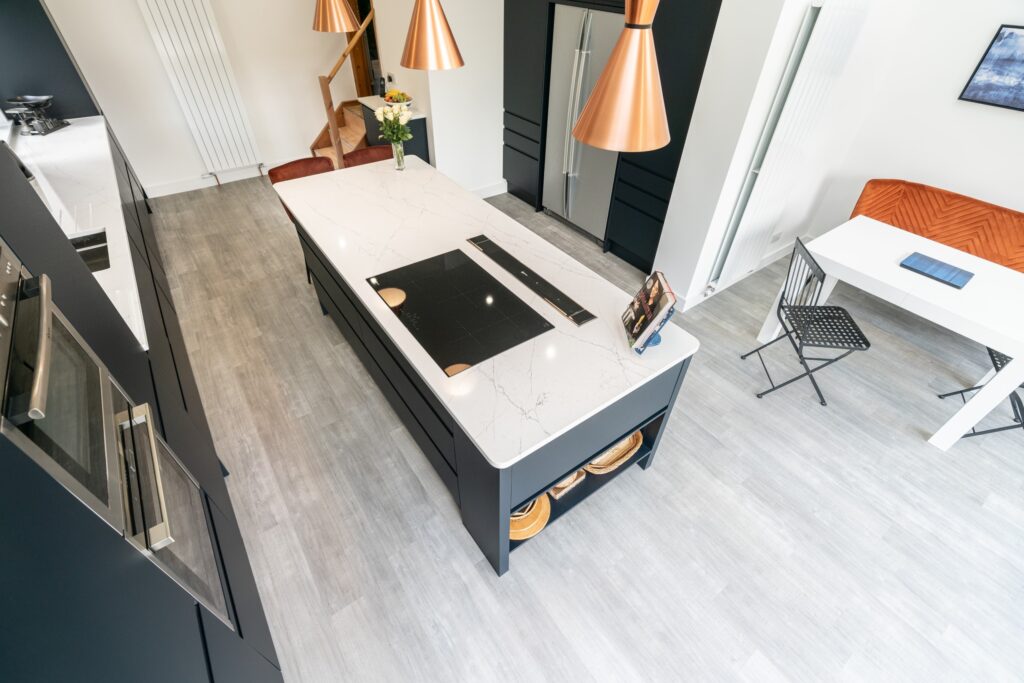
This is one of the most common questions we hear in our showroom, usually asked when someone has fallen in love with a particular slab. “Will there be a join, and will I be able to see it?”
It is a fair question, and when investing in a beautiful stone worktop, the last thing you want is a visible line running through it. The good news is that, with careful planning and skilled fabrication, joins in a modern stone worktop are far less noticeable than most people expect. Better still, with the right material and layout, they can sometimes be avoided altogether.
Here is our honest guide to worktop joins: why they happen, how visible they really are, and what you can do to minimise them.
Why Do Stone Worktops Need Joins?
Quite simply, stone comes in slabs, and slabs have a maximum size.
Most quartz, sintered stone and porcelain slabs are around 3 metres long and between 1.4 and 1.6 metres wide, depending on the brand and the format. Some manufacturers offer larger “jumbo” slabs with slightly more length and width. Natural granite slabs vary in size, as each block is cut from the quarry.
Any run of worktop longer than a single slab will need a join. L-shaped and U-shaped kitchens usually need joins at the corners, because cutting an entire L shape from one slab would waste a great deal of material and leave a fragile shape that is difficult to transport and install.
Beyond size, there are practical reasons too. You have to carry a worktop into your home, through doorways, around corners, and sometimes up stairs. Very long or awkwardly shaped pieces can simply be impossible to get into the room in one piece, even if a slab is big enough.
How Visible Are Worktop Joins?
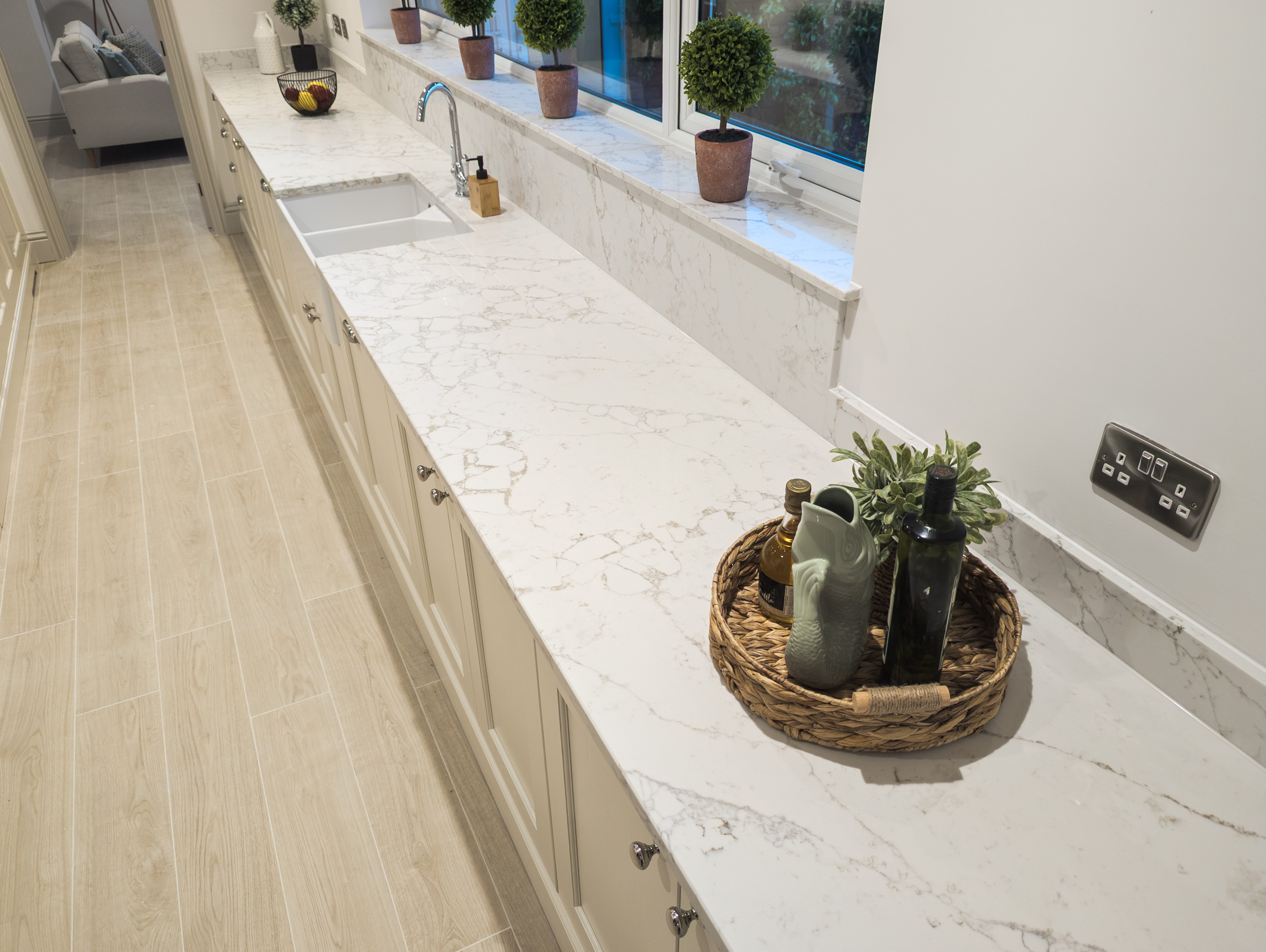
In short, a well-made join in a stone worktop is a fine line, typically around a millimetre wide, filled with a colour-matched resin and polished flush with the surface. You will be able to feel it with your fingertips if you go looking for it; you’ll usually know where it is, but most people stop noticing their joins within days.
How visible a join is depends on several things.
The Colour and Pattern of the Stone
Plain solid colours and fine, speckled patterns are most forgiving. Veined designs are the most challenging. If a dramatic vein runs to the edge of one piece and does not continue on the next, the break in the pattern can draw the eye far more than the join itself. That is why veined worktops need extra care at the planning stage.
The Finish
Polished surfaces reflect light, so a join can catch the light at certain angles. Matte, honed and textured finishes tend to disguise joins more effectively, because they diffuse light rather than reflecting it.
The Quality of the Fabrication
This is where the difference between a good join and a poor one really shows. A precise join depends on perfectly straight, CNC-cut edges, careful colour matching of the resin, accurate levelling during installation and a clean, flush finish. When any of these steps are rushed, you get gaps, lips, mismatched resin or a visible step between the two pieces.
The Lighting in Your Kitchen
Low, ranking light from a window or under-cabinet LEDs can make a join more visible, particularly on polished surfaces. It is worth thinking about where your light sources are when planning joint positions.

Do Joins Differ Between Quartz, Granite, Sintered Stone and Porcelain
All four materials can be joined well, but each has its own characteristics.
Quartz
Quartz is the most consistent material to join thanks to its engineering, colour and patterns, making it predictable from slab to slab, and the resin used for joins can be matched closely to the surface. Plain and lightly speckled quartz in particular gives some of the least visible joins of any material.
Granite
Granite is a natural stone, so its colour and pattern vary across a slab and from one slab to the next. An experienced fabricator will select and position pieces so that the pattern flows as naturally as possible. Busy, speckled granites hide joins very well; more uniform or strongly patterned granites need more care.
Sintered Stone
Sintered stone has a very precise, consistent surface and is often available in large formats, which can reduce the number of joins needed. However, many sintered stone designs have a pattern applied to the surface rather than one that runs right through the body, so joins and edge details need careful planning to keep the design continuous.
Porcelain
Porcelain is also produced in large-format slabs, so it can cover long runs with fewer joins. Like sintered stone, many porcelain designs carry their pattern on the surface, and the slabs are often thinner, so joins need precise cutting and firm, level support underneath to stay flush. Mitred edges are commonly used with porcelain to give a thicker look and keep the pattern flowing around corners.
Can You Avoid Worktop Joins Altogether?
Sometimes, yes. Whether you can depends on the size and shape of your kitchen and the material you choose.
Choose a Layout That Fits Within One Slab
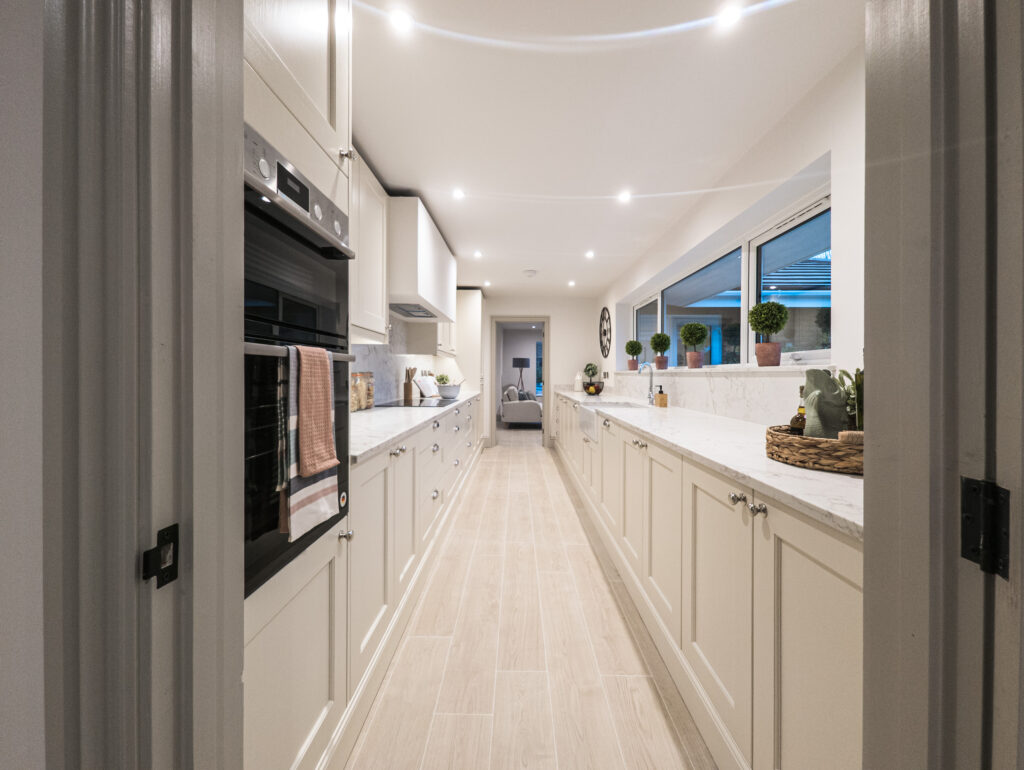
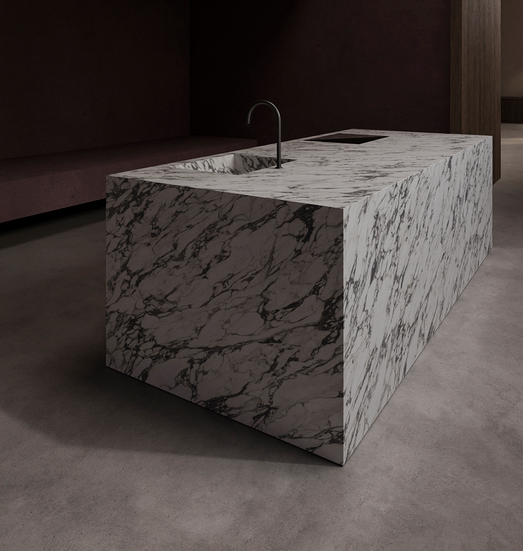
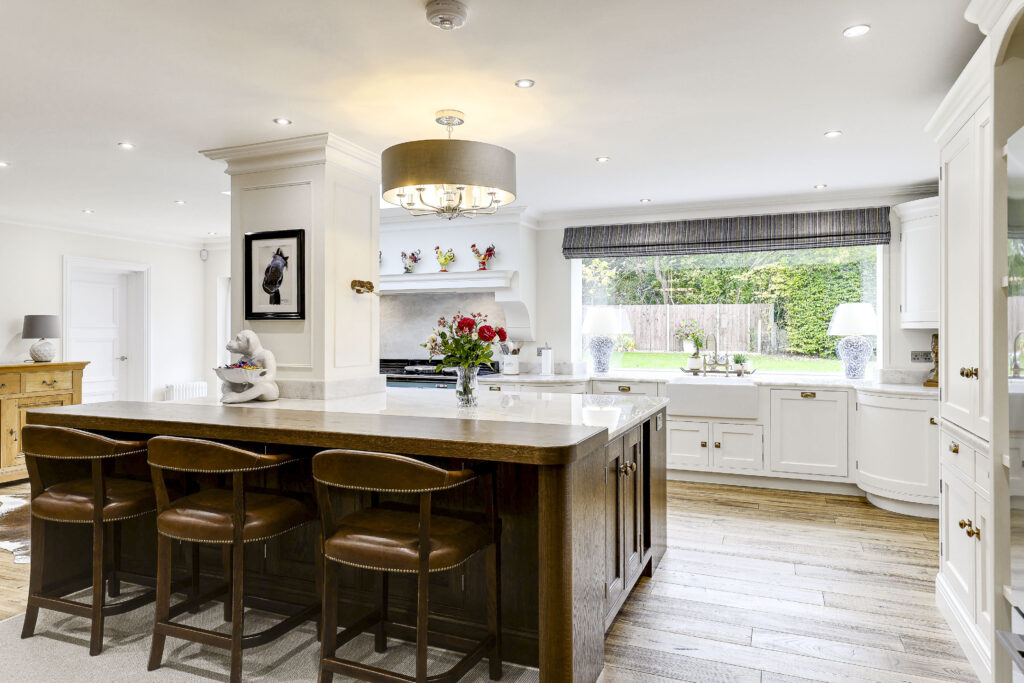
A straight run or an island that fits within the dimensions of a single slab can be made without any join at all. For islands, this is often achievable, which is one reason islands are such a popular place to showcase a dramatic stone.
Use Jumbo Slabs
Many brands offer larger jumbo formats. These can be the difference between a join and no join on a longer island or run, so it is worth asking about them early, as not every colour is available in every size.
Break the Worktop Naturally
Instead of joining two pieces in the middle of a run, a good designer will look for natural breaks: at a corner, either side of a tall unit, at a change in worktop height, or where a run meets a wall. A join that sits where the eye expects a change is far less noticeable than one in the middle of a clear surface.

Where Should Joins Go?
If joins are unavoidable, placement makes all the difference. As a general rule, we aim to:
- Place joins at corners or natural breaks, where they look intentional
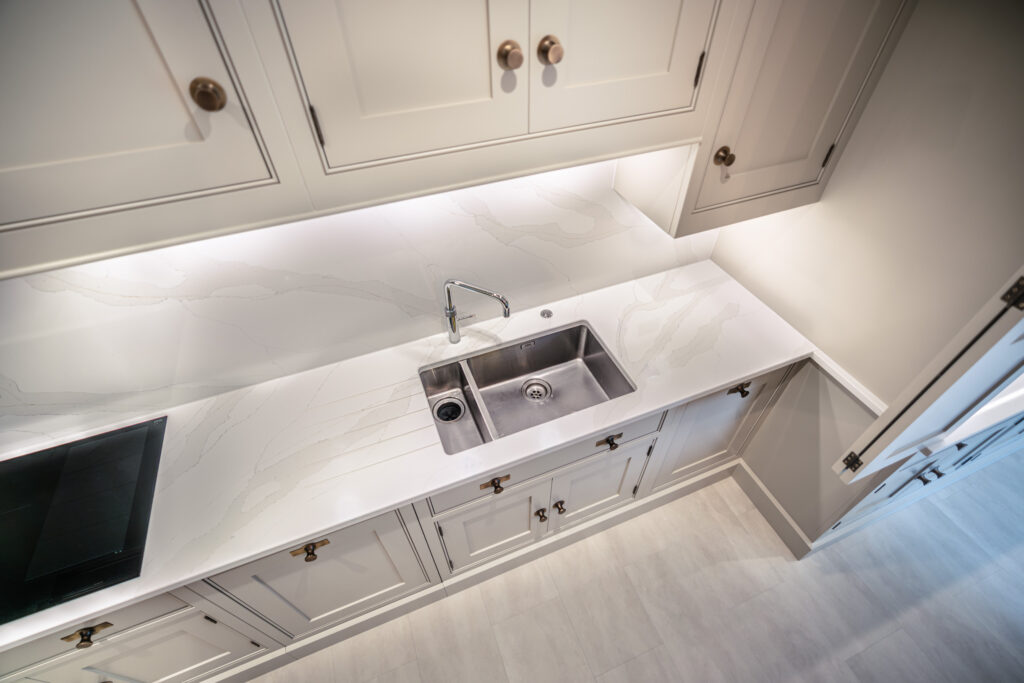
- Keep joins away from cutouts. A join running through a sink or hob cutout weakens the worktop and puts it in the area that gets the most heat and water
- Avoid the busiest working areas, such as the main prep zone
- Consider sightlines from the doorway and seating areas, so joins sit where they are least likely to be noticed
- Avoid strong raking light, where possible, particularly on polished finishes
These decisions are made during templating and layout planning, and it is well worth having the conversation with your fabricator before fabrication begins. We always discuss join positions with our customers so there are no surprises on fitting day.
Joins and Veined Worktops
If you have chosen a veined quartz, sintered stone or porcelain, such as a Calacatta-style design, join planning becomes even more important.
The key techniques are vein matching, where pieces are cut and positioned so the veins continue across the join as naturally as possible, and bookmatching, where consecutive slabs are opened up like the pages of a book to create a mirrored, symmetrical pattern. Bookmatching is often used deliberately on islands and splashbacks, turning what could have been a join into a striking design feature.
Both techniques require careful slab selection and layout planning. They can also use more material, so they may affect the cost. For a statement veined surface, however, the result is usually well worth it.
Will a Join Weaken My Worktop?
A properly made join, bonded with the correct adhesive and supported on level cabinets, is strong and durable and will last as long as the rest of the worktop. Problems usually come from poor support underneath, joins placed through cutouts, or rushed installation, rather than from the join itself.
To keep your joins looking their best, treat them like the rest of the worktop: wipe spills promptly, avoid standing directly on the worktop and use trivets for hot pans, particularly on quartz.

Related blogs:
Waterfall Edges vs. Traditional Overhangs: Which Kitchen Island Is Right for Your Style & Home?
Pairing the Perfect Design of Quartz Shelves & Splashbacks
Joins are a normal part of almost every stone kitchen, but they should never be an afterthought. With the right material, a carefully planned layout and precise CNC fabrication, they can be so discreet that you soon forget they are there.
Visit our showroom and discuss with the team slab sizes, join positions and vein matching before anything is cut, so you know exactly what to expect. Visit our Hertfordshire showroom to see our joins up close, compare materials and plan a worktop you will be proud of.