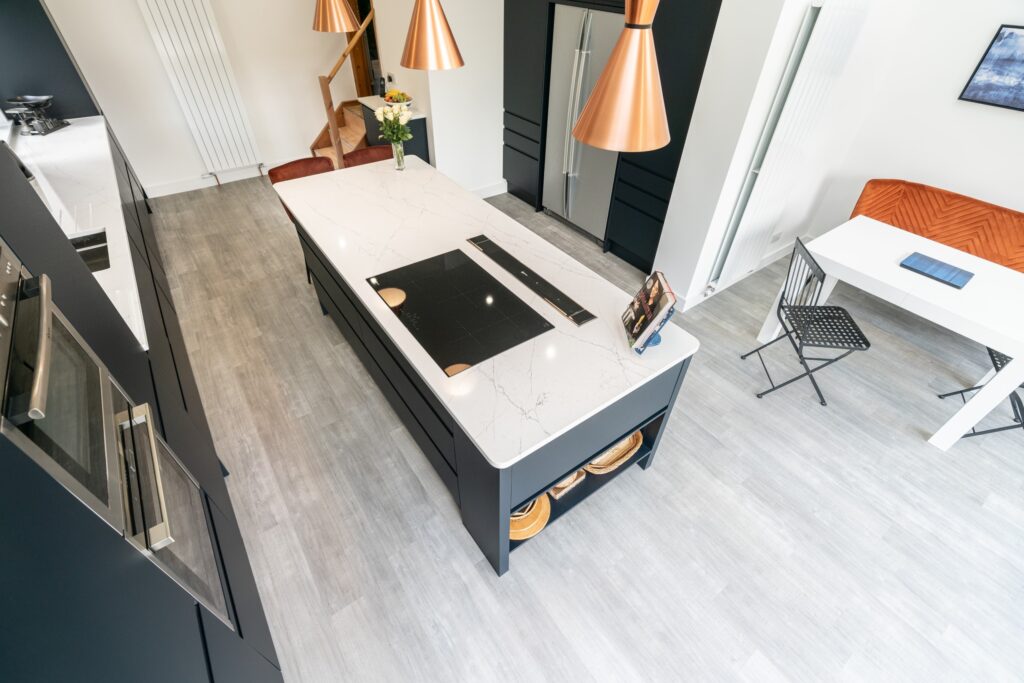
Where does your phone sit when you cook, eat, or read through a recipe? On the worktop, of course. It’s the most natural resting place for the device that never leaves your side, and it is also the place where the battery always seems to run flat.
Now imagine placing your phone down on your stone worktop and having it start charging automatically. No cable, charging pad or visible hardware, just your worktop doing something quite clever beneath the surface. That is exactly what wireless charging worktops do.
Wireless charging worktops are now available on the market, working through quartz, granite, sintered stone and porcelain. This is one of the smartest ways to future-proof a kitchen, but getting it right depends entirely on the worktop material you choose and how it is prepared.
Bring your home into the future with wireless charging built into your worktop. Our blog will cover all the basics of this innovative design and then some. We have 40 years of fabrication experience, and we are continually being asked about this.
Quick answer: how do wireless charging worktops work?
A wireless charging worktop uses a Qi charger mounted to the underside of the stone to transmit power through the surface to your phone. The technology works with quartz, granite, sintered stone and porcelain. Sintered stone at 12mm is the easiest to fit because no routing of the slab is required; quartz, granite and thicker porcelain at 20mm or 30mm need a shallow recess milled into the underside so the charger sits within transmission range.
How Do Wireless Charging Worktops Actually Work?
The technology behind it is Qi wireless charging, the same standard used by Apple, Samsung, Google and virtually every other smartphone manufacturer. A small charging unit is mounted to the underside of the worktop, completely hidden from view. When you place a Qi-compatible device on the surface above it, the charger transmits energy through the stone using electromagnetic induction, powering your phone without any physical connection. Clever, right?
From the outside, there is nothing to see. Some systems may include a subtle LED halo that glows through the surface, indicating the charging zone. The only clue is that your phone starts charging the moment you put it down.
The leading systems on the market:
Kew Labs
Delivering an enhanced design to transform your kitchen countertops into sleek, invisible wireless charging stations. Kew Labs is officially tested and approved with the world’s leading surface brands (to name a few: Cosentino, Caesarstone, Laminam, Neolith, Silestone and Dekton) to ensure their specifications are safe to install in your countertop and their technology performs as claimed.
Master Charge
Carefully designed and thoroughly tested, Master Charge’s award-winning technology enables wireless charging through various materials. With their technology, you can enjoy the convenience of an under-desk wireless charger seamlessly integrated into your surfaces, providing a clean and polished finish.
- 5mm to 30mm charge distance
- Up to 15W fast-charge
- Plenty of compatible surface materials

Which Worktop Materials Support Wireless Charging?
This is where choosing a new kitchen worktop becomes relevant, as the right surface material needs to perform well with the system, allowing the electromagnetic field to pass through and reach your device.
Wireless charging worktops at a glance:
- Sintered stone at 12mm: the easiest option, no routing required
- Porcelain at 12mm: works well, though less dense than sintered stone so performance can vary
- Quartz at 20mm or 30mm: fully compatible, underside routed to create a shallow recess
- Granite at 20mm or 30mm: fully compatible, same routing process as quartz
- Typical charge distance: 5mm to 30mm, up to 15W fast-charge
- Any worktop with a metallic component will block the electromagnetic field and will not work
Sintered Stone
Sintered stone surfaces such as Dekton, Neolith and Laminam are among the best materials for built-in wireless charging. Kew Labs, as previously mentioned, is one of the leading manufacturers of invisible worktop chargers and has tested and approved its systems specifically for use with Dekton surfaces.
There are two reasons sintered stone works so well. First, it is available in 12mm thickness, which is the ideal depth for wireless charging transmission. At 12mm, the charger can be mounted directly to the underside of the slab without any routing or thinning of the material, making installation simpler, faster and less expensive.
Secondly, sintered stone is extraordinarily dense and durable. There is no risk of it cracking during the routing process, and the surface does not become weakened by having a charging unit bonded to its underside.
For homeowners who want the cleanest possible installation with the least fabrication complexity, sintered stone in 12mm is the easiest route.

Quartz
Quartz worktops are fully compatible with wireless charging and, given their popularity in UK kitchens, this is the material most people consider. Brands like Silestone, Caesarstone, Artemistone, Technistone and CRL Quartz all work well with under-worktop charging systems.
However, quartz typically comes in 20mm or 30mm thicknesses, so the slab will usually need to be routed out on the underside, creating a shallow recess that brings the charging unit closer to the surface. We will mill a pocket into the underside of the stone, reducing the thickness in that specific area, and then the charger is bonded into the recess.

Granite
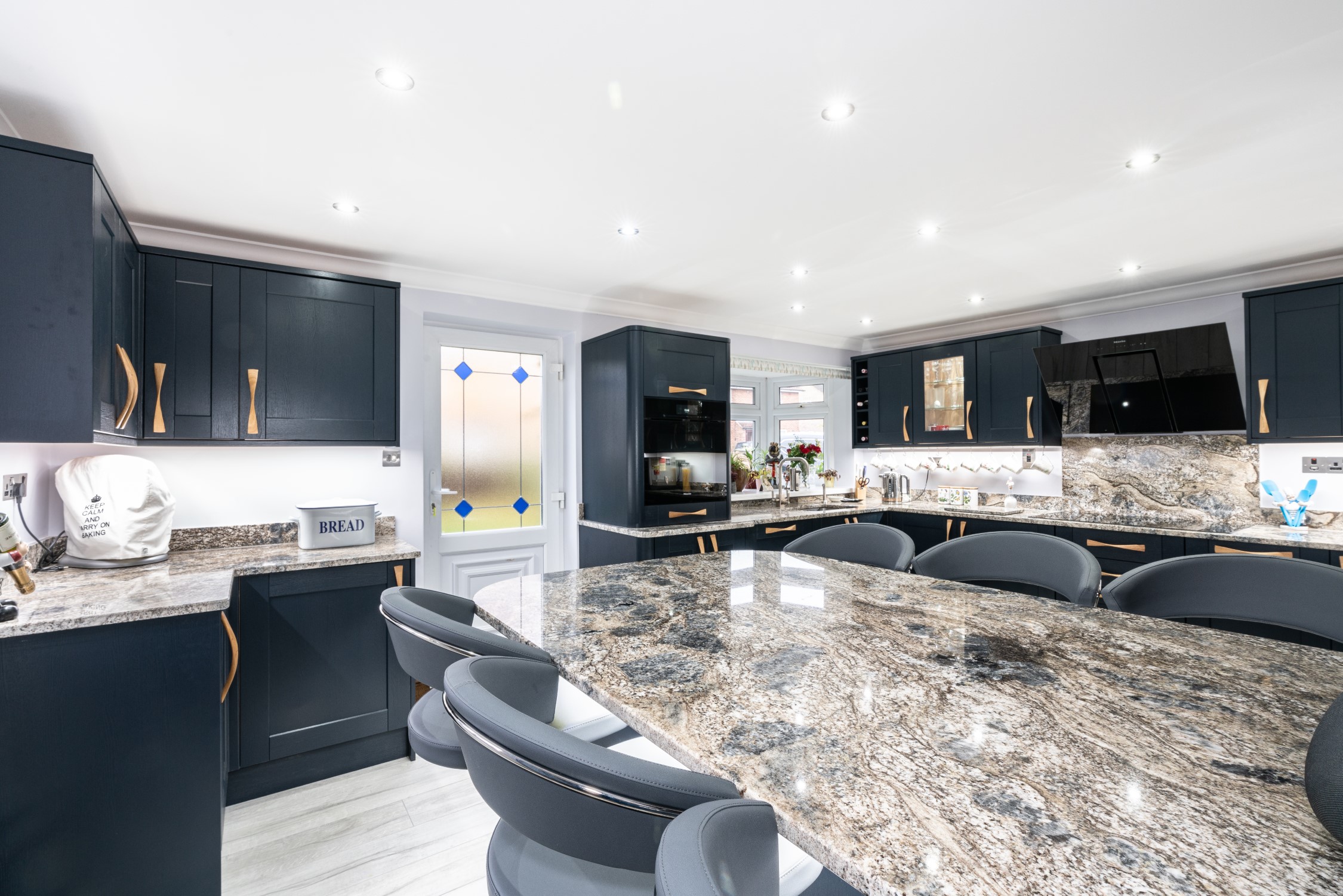
Granite is also compatible with wireless charging, and the same routing process applies as with quartz. It is a natural material, so an experienced fabricator will know how thin the stone can be routed without compromising its structural integrity. At Cawdor, we have been working with granite for four decades, so this is familiar territory for us.
Porcelain
Large-format porcelain slabs can support wireless charging at a 12mm thickness, like sintered stone. However, porcelain is generally less dense than sintered stone, so performance can vary.
Any worktop with a metallic component will block the electromagnetic field and won’t work.
Where Can Wireless Charging Worktops Be Placed?
Placement needs to be carefully considered, because once the charger is installed beneath the stone, it is there for good. The most popular position is on the kitchen island, close to where people naturally sit or stand while using their phones. Having a charging zone at one end of an island, near the seating area, means devices can charge while the rest of the worktop is getting used for prepping and cooking. It keeps cables off the surface and phones out of the food zone.
Another common choice is near the kettle or coffee area, inside a breakfast pantry, where phones tend to accumulate during the busy morning routines. A charging zone here means you start every day with a topped-up device without ever reaching for a cable.
For open-plan kitchens where the worktop doubles as a home office during the day, a charging zone near where a laptop or tablet sits can be particularly useful.
During the design stage, it’s important to decide on the placement before the worktop is fabricated. Your fabricator needs to know exactly where the routing will go, and the electrical connection needs to be planned into the cabinet below.

The Fabricator’s Job
This is where Cawdor Stone Gallery’s experience makes a genuine difference. We work with our clients to plan these details during the templating stage. Adding wireless charging installation to your kitchen isn’t complicated; it just requires coordination between the worktop fabricator, the electrician and, in some cases, the charging system supplier.
We prepare the slab correctly, routing the underside to the correct depth in the right positions and ensuring the recess is clean and level so the charging unit sits flush. For sintered stone at 12mm, no routing is needed, which is one of the reasons we often recommend it for technology-integrated kitchens.
For other materials, typically 20mm or 30mm (quartz and granite), the routing is a standard CNC operation that any competent stone fabricator can handle.
Are Wireless Charging Worktops Actually Worth It?
For a piece of technology that costs relatively little compared to the overall investment in a stone worktop, wireless charging delivers a surprising amount of daily convenience. You don’t need to hunt for cables anymore, your surfaces aren’t cluttered, and no more phones dying in the middle of that exciting recipe. Just a worktop that quietly keeps your devices powered while you get on with your day.
It can also be a genuine selling point if you ever move. Selling a home with a kitchen that has built-in wireless charging in the worktop signals a thoughtful, modern design, and a kind of detail buyers notice.
More importantly, it is a technology that works with the materials homeowners are already choosing. You do not need a special worktop; you just need a fabricator who understands how to prepare the surface correctly and a plan that accounts for charger placement before the slab is cut.
Wireless Charging Worktop FAQs
Which worktop material is best for wireless charging?
Sintered stone in 12mm is the easiest material to fit with a wireless charger because no routing of the slab is required. Quartz, granite and porcelain are all fully compatible, but the underside is usually milled to bring the charger closer to the surface.
Can wireless charging work through 30mm quartz or granite?
Yes. The slab is routed on the underside in the charging zone, creating a shallow recess that thins the stone to within the charger’s transmission range, typically 5mm to 30mm. This is a standard CNC operation for an experienced stone fabricator.
Will any phone work with a wireless charging worktop?
Any Qi-compatible device will work, which includes the vast majority of modern smartphones from Apple, Samsung, Google and others. Older phones without Qi can be paired with an inexpensive Qi-enabled case.
Can you see the charger in the worktop?
No. The charging unit is mounted entirely beneath the stone and is invisible from above. Some systems include a subtle LED halo that glows through the surface to indicate the charging zone, but otherwise the worktop looks completely ordinary.
How much does built-in wireless charging cost compared to the worktop?
The charging hardware itself is modest relative to the price of a stone worktop. The main considerations are slab preparation, the electrical connection beneath the cabinet, and coordination between your fabricator and electrician at the templating stage.
Where can I get a wireless charging worktop fitted in Hertfordshire?
Cawdor Stone Gallery prepares and installs wireless charging worktops from our Welwyn showroom in Hertfordshire, serving homeowners and kitchen designers across St Albans, Harpenden, Hertford, Hatfield, North London and the wider South East.
Related blogs:
What is InvisaCook? The Invisible Induction Hob Explained
Are Quartz Worktops Durable Enough for a Busy Kitchen?
Sintered Surfaces: Why Choose This Surface for the Home?
Are Porcelain Worktops Worth the Investment?
If you are planning a new kitchen and want to explore wireless charging as part of your worktop, we would love to help. We have many worktop materials that will work perfectly with under-worktop charging systems.
Visit our Welwyn showroom in Hertfordshire today to see the surface and talk through the practicalities of this modern feature. We work with clients across Hertfordshire, North London and the wider South East. Whether you want a single charging zone on your island or multiple zones across the kitchen, we can make sure your worktop is ready.