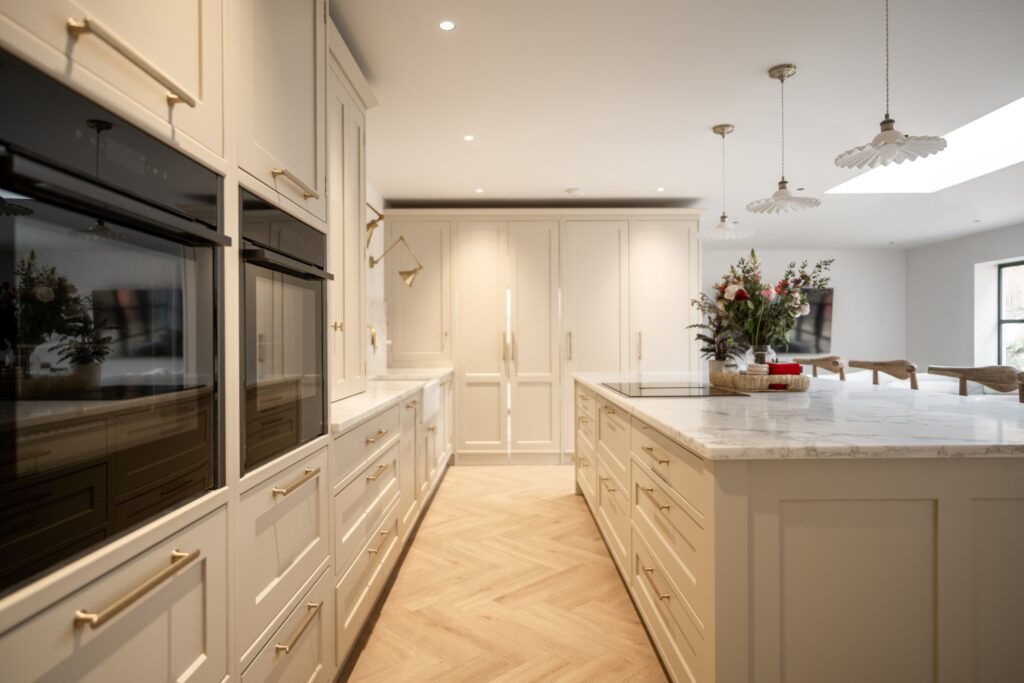
Before downdraft extractors hit the market, almost every kitchen had a cooker hood mounted on the wall or suspended above an island. It was a standard kitchen design that nobody questioned. Today, a growing number of homeowners are choosing to remove the overhead extractor entirely and replace it with a downdraft system that rises from within the worktop or sits flush alongside the hob.
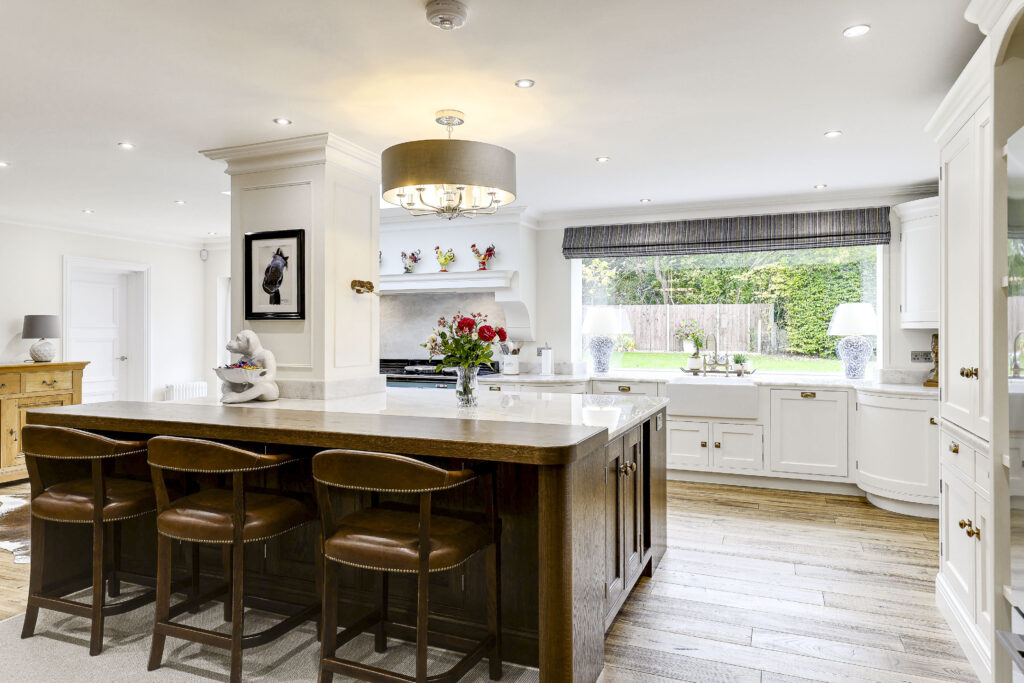
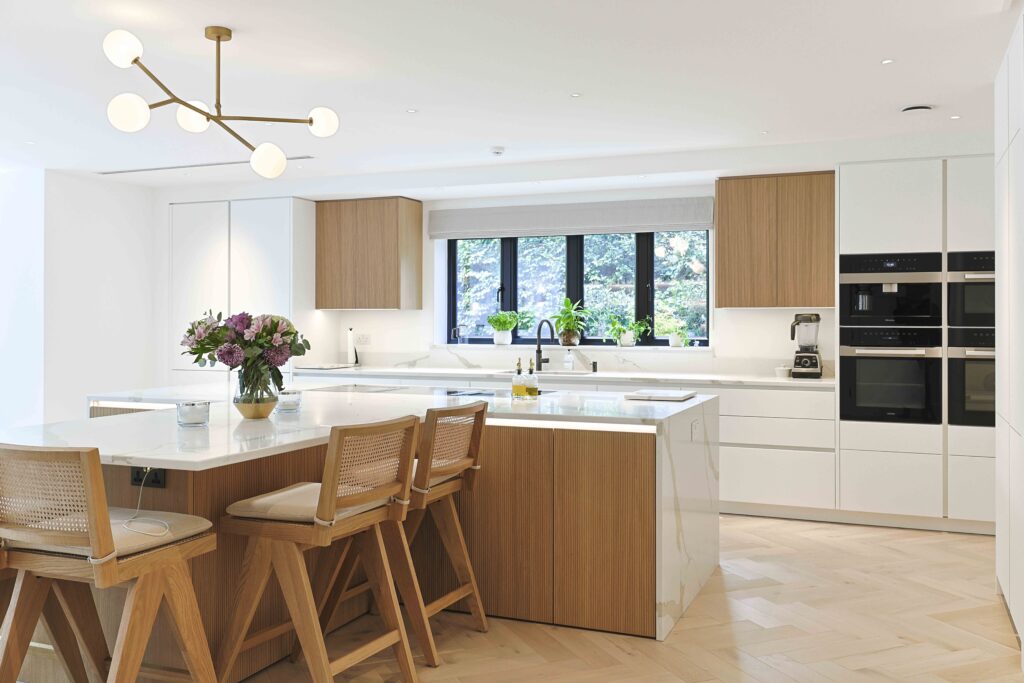
The appeal is obvious as you don’t have a bulky hood hanging above the cooking zone, and sightlines across the kitchen stay clear. Islands become centrepieces rather than surfaces dominated by an overhead canopy, and open-plan living and kitchen spaces feel connected rather than divided.
However, what many homeowners do not realise until they are well into the planning process is that a downdraft extractor has a direct and significant impact on the worktop. The layout, cutouts, material choice, thickness and depth of the stone all need to be considered differently when a downdraft system is part of the specification.
What is a Downdraft Extractor?
For anyone who wants to know what a downdraft extractor is, it’s a ventilation system that draws steam, grease and cooking odours downward rather than upward. Instead of a hood above the hob that captures rising air, the extractor is built into or behind the worktop and pulls air sideways and downward at the point of cooking.
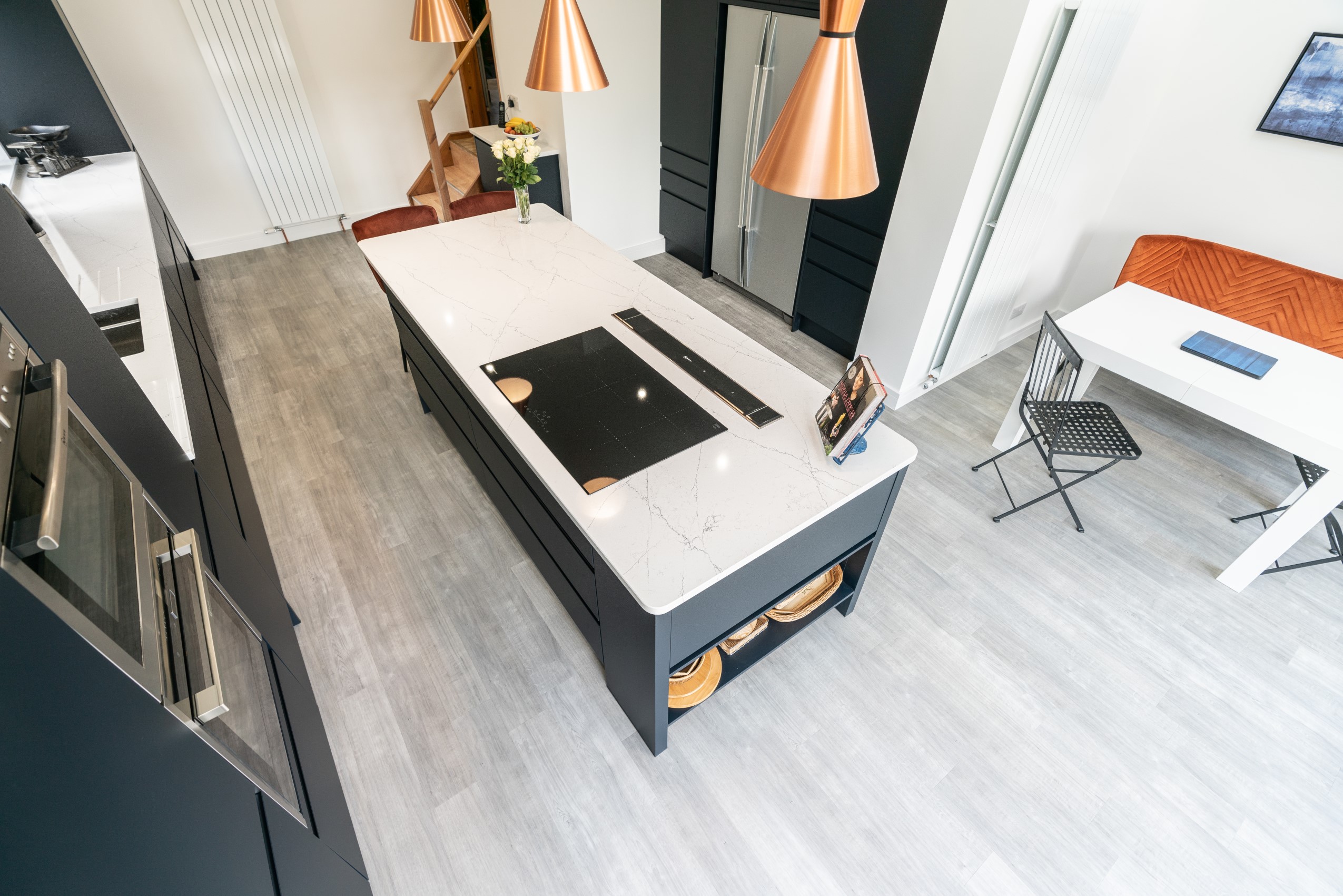
There are two main types. The first is a pop-up or telescopic model, which sits hidden below the worktop surface and rises at the push of a button when needed. When cooking is finished, it retracts back into the worktop and disappears entirely. The second is a flush-mounted system that sits permanently level with the worktop surface, usually in a narrow channel behind or beside the hob. Both achieve the same result: powerful extraction without anything visible above the worktop line.
Brands like Bora, NEFF, Miele, Siemens and Elica all offer downdraft models, and the technology has improved substantially in the past few years. Extraction rates now rival or exceed many traditional overhead hoods, and noise levels have dropped considerably. For homeowners who prioritise a clean, minimal aesthetic, particularly on a kitchen island, the downdraft extractor has become the go-to choice.

How a Downdraft Extractor Changes Your Worktop Layout
This is where the conversation moves from appliance to stone, and where your worktop fabricator becomes central to the project.
Worktop Depth
A traditional kitchen run against a wall typically uses a worktop depth of 600mm to 620mm. This accommodates standard base units with a small overhang at the front and the worktop sitting flush against the wall at the back.
A downdraft extractor changes this calculation. Pop-up models require space behind the hob for the extractor mechanism, which typically adds between 100mm and 300mm to the depth needed. For the worktop to accommodate both the hob and extractor, the cooking zone may need to be 750mm, 800mm or even 900mm deep.
For a kitchen island, this is usually less of an issue because islands tend to be deeper than wall runs anyway. Nevertheless, the extractor still needs to be accounted for in the overall island dimensions. The depth of the worktop, the position of the hob, and the space required for the extractor mechanism all need to work together as a single, coordinated layout.
Wall-mounted runs, the increased depth can be more challenging. The units housing the hob and extractor may need to project forward from the wall, creating what is known as a breakfront. This stepped layout requires careful worktop planning to ensure the transition between the deeper section and the standard-depth run on either side is handled cleanly. From a fabrication perspective, this means additional cuts, joins and potentially a more complex templating process.
Cutout Precision
Every downdraft extractor has specific cutout dimensions that must be followed exactly. Unlike a standard hob cutout, which is a straightforward rectangle, a downdraft system often requires a more complex opening that accommodates both the hob and the extractor in a single, integrated cutout.
It’s tight on measurement, as a millimetre too wide and the extractor will not seal properly. A millimetre too narrow and it will not fit at all. For pop-up models, the cutout also needs to accommodate the mechanism’s travel, meaning there must be sufficient clearance for the unit to rise and retract smoothly without catching on the stone.
This is precision CNC work, and it requires accurate manufacturer specifications well before the fabrication begins. At Cawdor, we always request the full technical drawings for the extractor manufacturer first before we template the worktop, because the cutout dimensions dictate where everything else sits.
Under-Worktop Clearance
A downdraft extractor does not just require space in the worktop surface. It also needs significant clearance beneath it. The motor housing, ducting or recirculation filters, and, in the case of pop-up models, the retractable mechanism all sit in the cabinet below. This means the base unit beneath the hob and extractor cannot contain drawers or shelving in the conventional sense.
While this is primarily a cabinetry and kitchen design consideration, it also affects the worktop. The stone needs to be adequately supported around the cutout area, particularly on larger islands where the hob and extractor are positioned centrally. Your fabricator will need to know what is underneath the worktop to advise on material thickness and support requirements.

Which Worktop Materials Work Best With Downdraft Extractors?
Not all materials handle the demands of a downdraft installation equally well. The material needs to be strong, stable, and capable of being fabricated to precise specifications for the larger cutouts, tighter tolerances, and proximity to heat and steam.
Sintered Stone
Sintered stone surfaces like Dekton, Neolith, Laminam and Ascale are exceptionally well suited to downdraft extractor installations. The material is sense, dimensionally stable and resistant to both heat and moisture, all of which are important when the worktop is in close contact with a cooking and extraction system.
It can be machined to extremely tight tolerances using CNC equipment, which is essential for the precision cutouts that downdraft systems demand. It holds its edge cleanly without chipping, and the zero-porosity surface means steam and grease from the extractor zone do not penetrate the stone over time.
For island installations where a large, unbroken run of stone is desirable, sintered stone’s availability in jumbo slab formats also means fewer joins across the cooking zone, which is both aesthetically and practically advantageous.
Quartz
Quartz is the most popular kitchen worktop material in the UK, and it works perfectly well with downdraft extractors. Brands like Silestone, Caesarstone, Artemistone, Technistone and CRL Quartz can all be fabricated to the required cutout specifications.
The main consideration with quartz is heat. While the downdraft extractor itself does not generate heat, it sits directly adjacent to the hob, and the cooking zone is where the worktop is exposed to the highest temperatures. As we have discussed in previous posts, quartz contains polymer resins that can be affected by sustained heat above 150℃. Provided trivets are used for hot pans, and the hob is correctly installed with appropriate spacing from the stone, this is not a problem. Nonetheless, it is worth being aware of, particularly with high-powered induction hobs that can generate significant residual heat around the cooking zone.
Quartz also machines beautifully, so the precision cutouts required for downdraft systems are straightforward for an experienced fabricator.
Granite
Natural granite is a strong, heat-resistant material that handles downdraft installations well. It can be cut to the required specifications, and its natural tolerance for high temperatures means there are no concerns about the proximity of the hob and extractor.
However, because granite is a natural material, slab thicknesses and structural integrity vary. Larger cutouts, particularly the combined hob-and-extractor openings that some downdraft systems require, remove more material from the slab. Your fabricator will need to assess whether the remaining stone around the cutout is thick and strong enough to support the worktop safely. In most cases, it is, but this is a judgement call that requires experience with the specific granite being used.
Porcelain
Large-format porcelain slabs can accommodate downdraft extractors, although the material is thinner and more brittle than sintered stone or quartz. The cutout area needs to be reinforced, and the fabrication tolerances are less forgiving. It is a workable solution in the right circumstances, but porcelain requires more careful handling during the cutting and installation process.
The Joins: Where the Extractor Meets the Stone
One detail that homeowners often overlook is how the extractor interfaces with the worktop surface. With a traditional hob, the cutout is covered by the appliance, and a simple seal around the edge does the job. With a downdraft system, particularly a pop-up model, the join between the stone and the moving mechanism is visible and needs to look clean.
The trim of the extractor sits against the cut edge of the stone, and if the cutout is not perfectly straight and smooth, the trim will not sit flush, and you’ll see uneven gaps. On a polished quartz or sintered stone surface, even a fraction of a millimetre gap is noticeable.
This is one of the reasons we always recommend CNC-machined cutouts rather than hand-cut openings for downdraft installations. The precision is consistently higher, and the finished result is visibly cleaner. At Cawdor, every downdraft cutout is CNC-machined using the manufacturer’s exact specifications, which ensures a tight, even fit between the stone and the appliance.
Planning a Downdraft Kitchen: What We Advise Our Customers
After fabricating worktops for hundreds of kitchens with downdraft extractors, we consistently advise at Cawdor on how to plan for your appliance.
First, choose your extractor before you choose your worktop. The extractor model dictates the cutout dimensions, the required worktop depth and the under-surface clearance. Without those specifications locked in, we cannot template or fabricate accurately.
Second, share the manufacturer’s technical drawings with your fabricator early. We need the exact cutout dimensions, the recommended spacing between hob and extractor, and any specific tolerances or clearance requirements. The earlier we have this information, the smoother the process.
Third, think carefully about material and thickness. If you are drawn to a sleek, modern kitchen with an island and a downdraft extractor, sintered stone in 12 mm or 20 mm thickness gives you the cleanest possible look and the best performance. If quartz is your preference, a 20mm slab provides the right balance of aesthetics and structural integrity around the cutout. If you fancy granite, talk to us about which specific slabs have the density and consistency to support the larger openings.
Finally, do not treat the worktop and the extractor as separate decisions. They are connected, and the best results come from planning them together from the outset.

Related blogs:
What is InvisaCook? The Invisible Induction Hob Explained
Can Quartz Worktops Handle Everyday Kitchen Life?
The Wonders of How Worktops Influence Kitchen Aesthetics
Let Cawdor Stone help you get the details right. A downdraft extractor can transform the look and feel of a kitchen, but only if the worktop is specified, fabricated and installed to match. We have 40 years of fabrication experience, and we work with every material a downdraft installation might require: sintered stone from Dekton, Neolith, Laminam and Ascale. Quartz from Silestone, Caesarstone, Artemistone, Technistone and CRL Quartz, and a wide selection of natural granite.
If you are planning a kitchen with a downdraft extractor, visit our Hertfordshire showroom to discuss the project with our team. We can advise on the right material, plan the cutout specifications, and make sure your worktop and extractor work together perfectly.