Throughout our time in the stone industry, the worktop’s relationship with technology was straightforward. You cut a hole for the hob, another for the sink, maybe a few smaller openings for pop-up sockets, and the job was done. The stone was the surface, and the technology sat on top of it or was dropped into it, and the two existed largely independently of each other.
That relationship is changing fast. Today, the worktop is no longer just the surface appliances sit on. It is becoming the surface that appliances work through. Invisible induction hobs cook through the stone. Wireless chargers transmit power from beneath them. Downdraft extractors rise from within it. Integrated lighting glows through its edges. The worktop is evolving from a passive platform into an active component of the kitchen’s technology system.
As stone fabricators who have been working with these materials for 40 years, we see these changes up close each week. The specifications are getting more complex, the tolerances are getting tighter, and the conversations we have with customers are fundamentally different from the ones we were having even five years ago. Here is what is changing, and what it means for anyone planning a kitchen today.
The Invisible Kitchen: Technology You Feel But Do Not See
The single biggest design trend driving worktop innovation in 2026 is the push towards invisible technology. The goal is to create a kitchen with seamless and uninterrupted surfaces, while appliances and systems are present but not visible.
This is the shift in how homeowners now want their kitchens to feel. Open-plan living has made the kitchen the most visible room in the house, and as a result, every element in it is being held to a higher design standard. Bulky overhead extractors, chunky hob frames and visible cables are being replaced by systems that integrate into the space’s architecture.
For the worktop, it means everything is moving beneath, behind or through the stone surface. And that means the stone itself has to do more than look beautiful; it has to perform.

Invisible Induction: Cooking Through Stone
Perhaps the most dramatic example of this shift is the invisible induction hob, like InvisaCook. It features electromagnetic coils beneath the worktop, allowing you to cook directly on what appears to be an unbroken sweep of stone. There is no glass cooktop, no visible burners, no cutout. The hob simply disappears.
From a worktop perspective, this technology places entirely new demands on the material. The stone needs to allow electromagnetic energy to pass through it efficiently. It needs to withstand the thermal cycling that occurs when a hot pan sits on the surface for extended periods. And it needs to be the correct thickness, typically 12mm or 20mm, for the induction to work properly.
What is significant is that the worktop is no longer just sitting passively beneath a hob. It is an active part of the cooking system. The fabricator is no longer cutting a hole and dropping an appliance in. Instead, the entire slab has to be specified with the technology in mind from the outset.

Downdraft Extraction: Reclaiming the Space Above
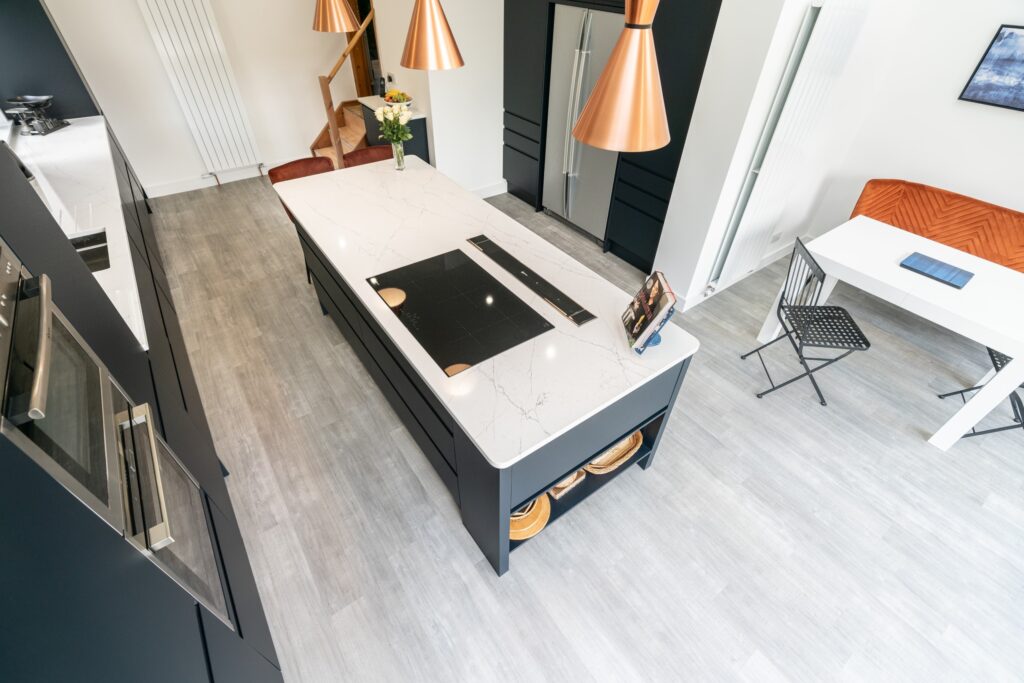
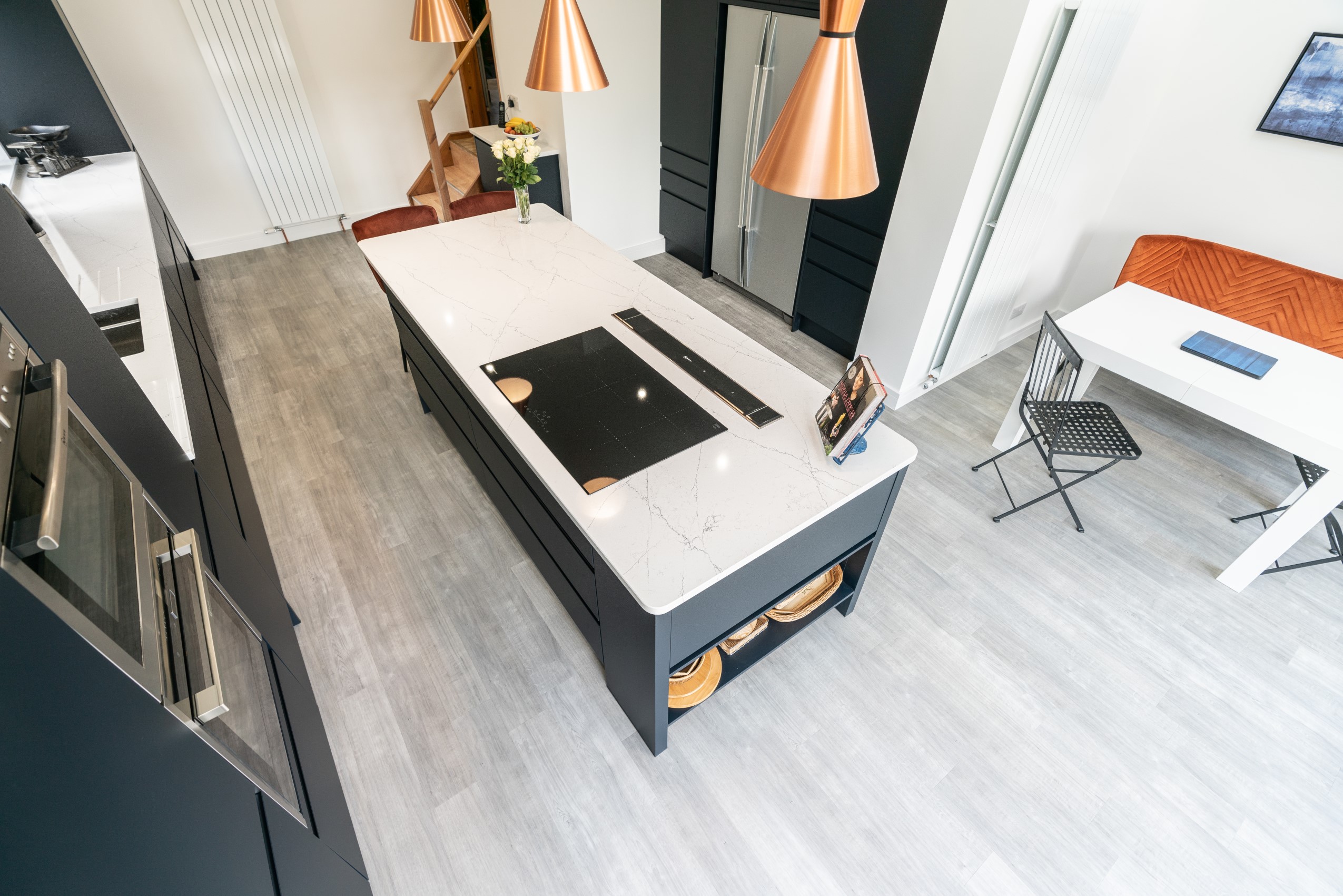
Alongside invisible induction, downdraft extractors are reshaping the layout of kitchen worktops. By pulling steam and cooking odours downward rather than upward, these systems eliminate the need for an overhead hood, freeing the space above islands and cooking zones.
However, this freedom comes with specific worktop requirements. Downdraft extractors need deeper worktops, sometimes 800mm or 900mm rather than the standard 600m, to accommodate the extraction mechanism behind the hob. Pop-up models require precise cutouts with tight tolerances, because the moving mechanism needs to rise and retract smoothly against the stone edge. Flush-mounted systems demand an even, level surface with millimetre accuracy.
Furthermore, the under-worktop space is affected because the motor housing and ducting occupy the cabinet beneath, which influences how the worktop is supported. On a large island with both a hob and a downdraft extractor, the stone fabricator needs to know exactly what is happening underneath the surface in order to advise on thickness, support rails and structural integrity around the cutout zones.
The broader point is that a downdraft extractor is not simply swapped in for a traditional hood; instead, it triggers a cascade of layout decisions that all flow through the worktop specification.
Wireless Charging: Power Through Stone
Built-in wireless charging is a quieter revolution than invisible induction, but it is arguably more widely applicable. Smaller charging units mount to the underside of the worktop, transmitting Qi wireless power through the stone, allowing phones, earbuds and other compatible devices to charge simply by being placed on the surface.
The technology works through all non-metallic worktop materials such as quartz, granite, sintered stone and porcelain, which are all compatible. It all comes down to the thickness of the worktop. Most wireless charging systems perform best when the transmission distance is 12mm or less. Sintered stone at 12mm thickness can accept a charger directly without modification. Quartz and granite at 20mm and 30mm typically need a shallow recess routed into the underside to bring the charger closer to the surface.
This type of technology needs to be planned during the design phase, as the routing position has to be agreed upon before fabrication. The electrical connection needs to be planned into the cabinetry below, and the charger placement needs to suit how the household actually uses the kitchen.
Flush-Fit Hobs & Integrated Sinks: The Seamless Surface
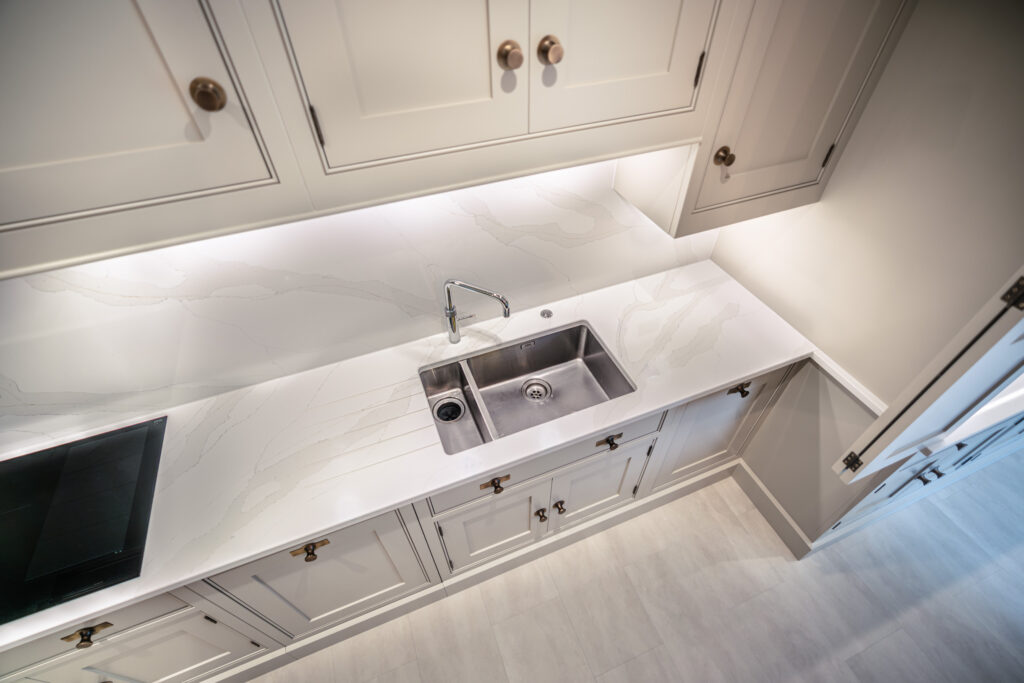
Beyond the headline technologies we hear about, there is a broader movement towards flush-fit installation of everything that sits in or on the worktop. Flush-fit hobs, where the glass cooktop sits perfectly level with the stone surface rather than proud of it, have become the default in high-end kitchen design. Integrated sinks, either undermounted or fabricated from the same material as the worktop, create a continuous surface with no visible rim or raised edge.
This raises the precision bar significantly, and the cutout depth, the rebate around the edge, and the levelling of the appliance within the stone all need to be exact. A flush-fit hob that sits even a fraction of a millimetre above the worktop surface will catch crumbs and create a visible line. One that sits below will collect liquid in the gap.
Integrated drainage grooves, carved directly into the stone surface beside the sink, show that the worktop is working hard. It is machined with shallow channels that direct water back towards the sink. This subtle detail requires CNC precision and a material that can hold clean, sharp groove edges over years of daily use.
These details might seem small; however, they represent a fundamental shift in what a worktop is expected to do. The surface now acts as a precision-engineered component with multiple integrated functions.

Pop-Up Sockets & Connectivity Hubs
The days of a row of plug sockets on the splashback above the worktop are long gone. Pop-up sockets have now emerged as the next best thing to having a plug socket within reach but not exactly in view. They emerge from the worktop at the push of a button and retract flush when not in use. These typically include a combination of three-pin sockets, USB-A and USB-C charging ports, and sometimes even integrated Bluetooth speakers.
From a fabrication perspective, each pop-up unit requires a circular or rectangular cutout in the stone, usually 80mm to 120mm in diameter. The position needs to be planned carefully: close enough to where appliances are used to be practical, but far enough from the hob and sink to avoid heat and water. On an island, the socket tower often sits at one end, near the seating area, doubling as a device charging point.
What This Means For Material Choice
Choosing the material isn’t just about the colour, finish and price; it’s about performance, machinability and compatibility with the systems.
Sintered stone and porcelain have emerged as the materials most naturally aligned with the tech-integrated kitchen. Its heat resistance suits invisible induction. Its density and thinness suit wireless charging. Its dimensional stability handles the precision cutouts that downdraft extractors and flush-fit installations demand. Its zero porosity means steam and moisture from extraction zones do not penetrate the surface over time. This is why we are seeing more of these surfaces in modern kitchens specified in technology-led kitchen projects.
Quartz remains the most popular worktop material in UK kitchens, and it handles the vast majority of integrated technologies extremely well. Wireless charging, pop-up sockets, flush-fit hobs, integrated sinks and downdraft extractors all work beautifully with quartz. The only area where quartz needs careful consideration is sustained high heat, which is specifically relevant for invisible induction installations.
Granite continues to be a strong choice for homeowners who prefer natural stone and integrated technology. Its heat resistance is excellent, it machines well, and its unique visual character adds something that no engineered surface can replicate. The main consideration is ensuring the specific slab has the density and consistency to support larger cutouts and routed areas.

Why the Fabricator’s Role is Changing
In technology-integrated kitchens, the worktop fabricator is no longer just cutting and polishing stone. They are coordinating with kitchen designers, appliance manufacturers, electricians and installers to ensure that every cutout, every recess, every routed area and every support rail is specified correctly before a single cut is made.
At Cawdor Stone Gallery, we have seen this shift firsthand over the past decade. The briefs we receive today are more detailed, more technical and more demanding than anything we dealt with in the early years of the business. A single island worktop might include a flush-fit induction hob, a downdraft extractor cutout, a wireless charging zone with underside routing, a pop-up socket tower, an undermount sink, integrated drainage grooves, and a waterfall edge return. Every one of those elements needs to be planned, templated and fabricated as part of a single, coordinated process.
This is one of the most exciting times to be a stone fabricator, as the materials and technology are pushing each other forward. The results speak for themselves.
Future-Proofing Your Worktop
If you are planning a kitchen now, the smartest thing you can do is think about technology early. Even if you aren’t ready to commit to invisible induction or built-in wireless charging, choosing the right material and thickness means you can add these technologies later without replacing the worktop.
The kitchens being designed in 2026 are beautiful, intelligent, integrated and considered.

Related blogs:
The Rise of the Downdraft Extractor: How It Affects Your Worktop Layout and Material Choice
Wireless Charging Built Into Your Worktop: How It Works and Which Surfaces Support It
What is InvisaCook? The Invisible Induction Hob Explained
Can You Put Hot Pans on Sintered Stone? What You Need to Know Before You Buy
Cawdor can help you plan a smarter kitchen with a range of different materials on offer. We fabricate all with the precision that technology-integrated kitchens demand. Visit our Hertfordshire showroom today to see the materials, discuss your project, and work with a team that has 40 years of experience in making stone do extraordinary things.