Quick answer: To show off a veined quartz worktop, layer your kitchen lighting for quartz worktops. Natural daylight from a side-on window reveals depth in the veining; under-cabinet LED strips graze the surface to highlight pattern detail; pendant lights spotlight key sections of an island; angled recessed downlights provide background fill. Polished finishes reward directional light with bright highlights, matte finishes scatter light softly for a contemporary look.
One of the most striking surfaces you can put in the kitchen is a veined quartz worktop. It is full of movement and depth and will instantly draw the eye the moment you or a guest walks into the room. Yet there is one thing that often gets overlooked: the wrong kitchen lighting for quartz worktops can flatten all of that character completely.
If a veined surface appeals to you, here are the smarter design choices to make during your kitchen renovation across Hertfordshire, St Albans, Welwyn Garden City, Harpenden and Barnet to make the stone the star of the show.
Why Does Lighting Matter So Much for Veined Quartz?
Not every worktop responds to light in the same way. If you have chosen a plain, solid-coloured quartz, it will look the same across the whole of the surface wherever it is lit.
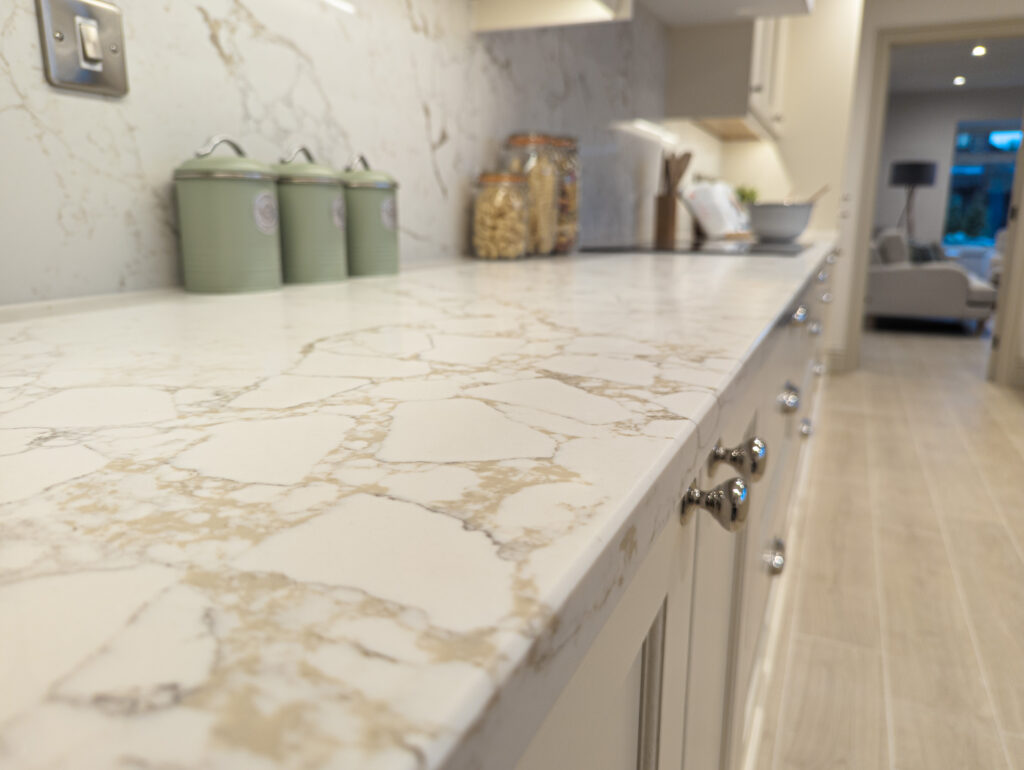
Veined quartz, on the other hand, tells a different story. The veining is created using multiple layers of pigment and mineral within the slab, and these layers sit at slightly different depths beneath the surface. Because of how it is made, the light hits the stone differently, changing how much of that depth and detail you actually see. A strong, directional light raking across the surface will pick up the veining and bring it to life, whereas a flat, overhead light will wash it out.
Seeing it in a showroom compared to a dimly lit kitchen can completely change the look of the stone. It is not the stone that has changed; it is the light.

How Does Natural Daylight Affect Quartz Worktops?
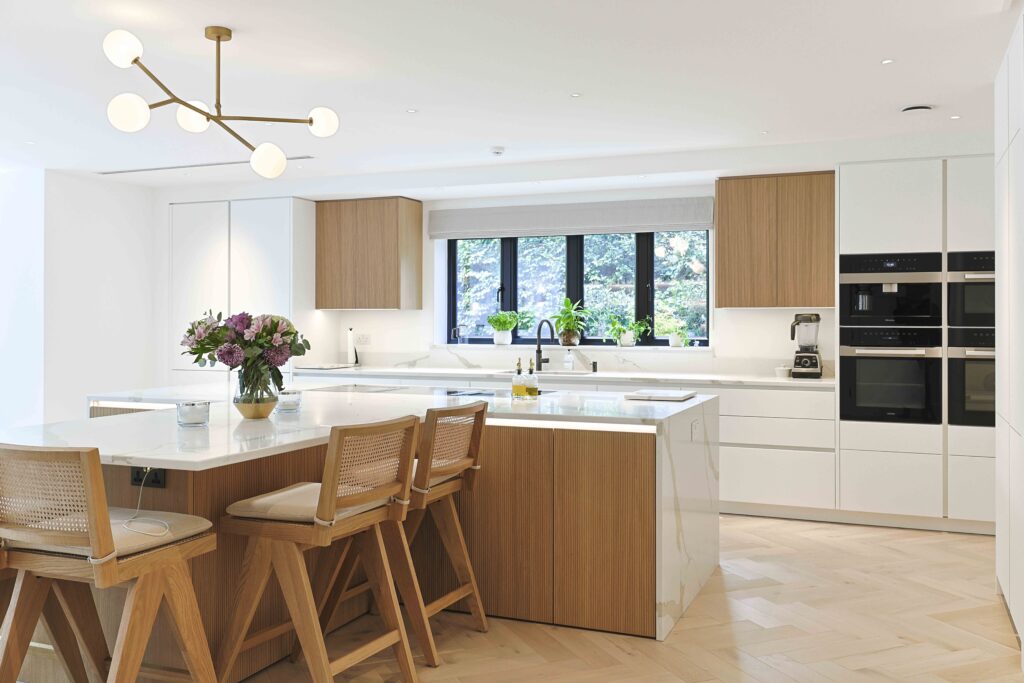
Without question, natural light is the most flattering source for veined quartz. Letting natural daylight enter the kitchen space allows the subtle tonal variations of the veins to show themselves fully. Those warm golden tones, cool grey undertones and the faint shimmer of metallic particles all come to life under daylight.
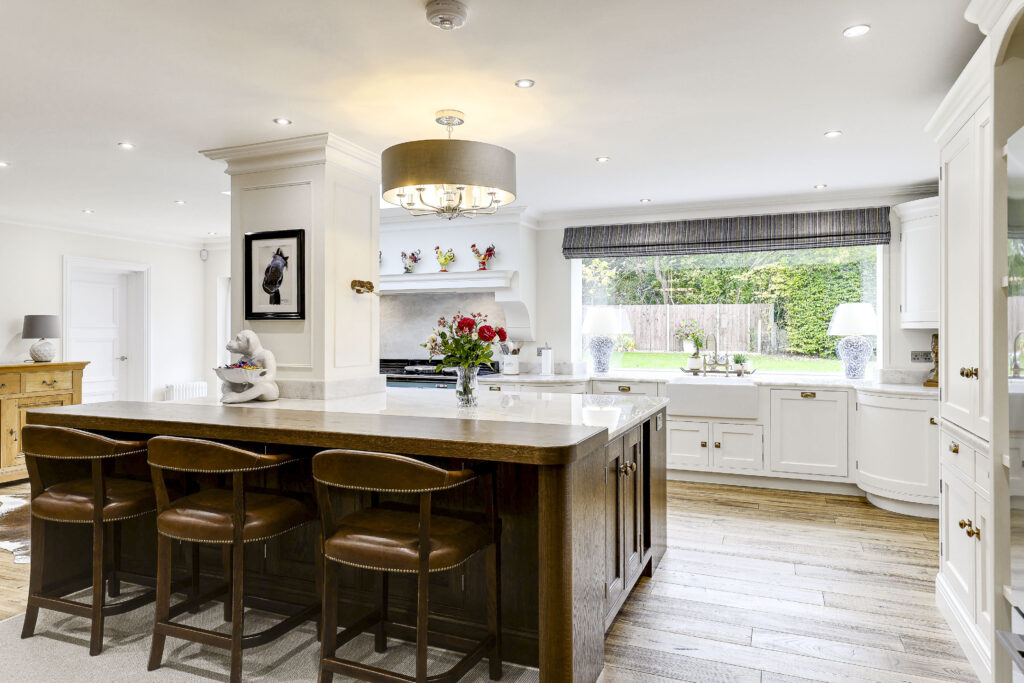
If your worktops are near your windows, you are already at an advantage. What makes this effective is the side light: daylight falling across the surface rather than straight down onto it. This creates gentle shadows within the veining that give the pattern a sense of three-dimensional depth, the same principle interior photographers use when capturing stone surfaces.
Wherever possible, consider the orientation of your kitchen when planning your worktop layout. A north-facing window will give you cool, consistent light throughout the day, suiting a veined quartz with tones of grey and white. A south or west-facing window will bring warmer, more golden tones, especially in the afternoon, which can add richness to cream, beige and warm-toned surfaces.
Why Is Under-Cabinet Lighting Essential for Quartz?
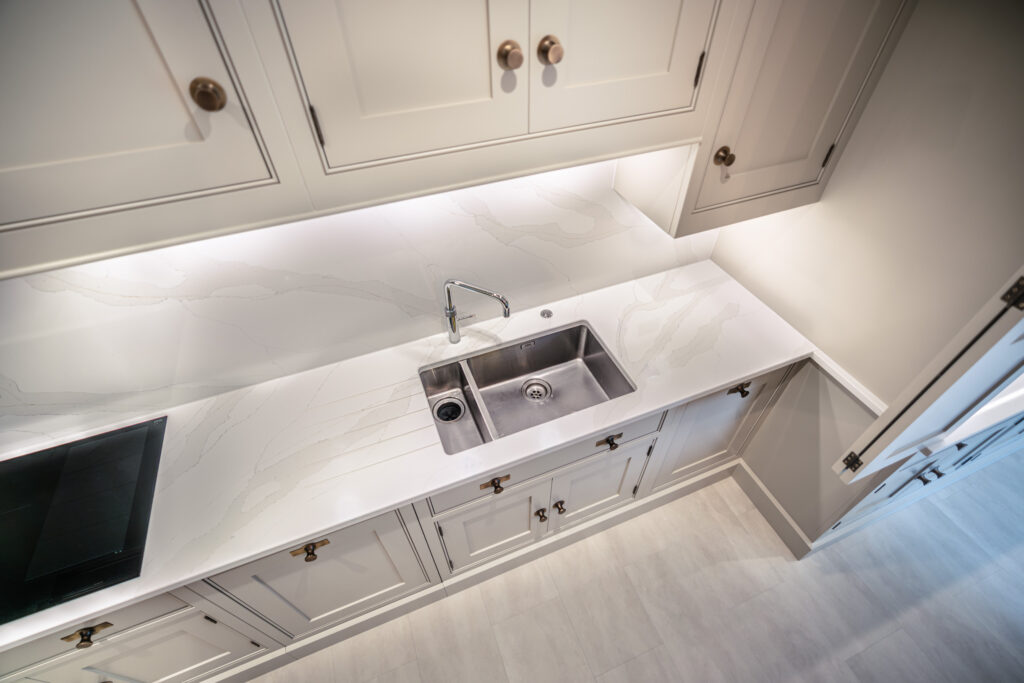
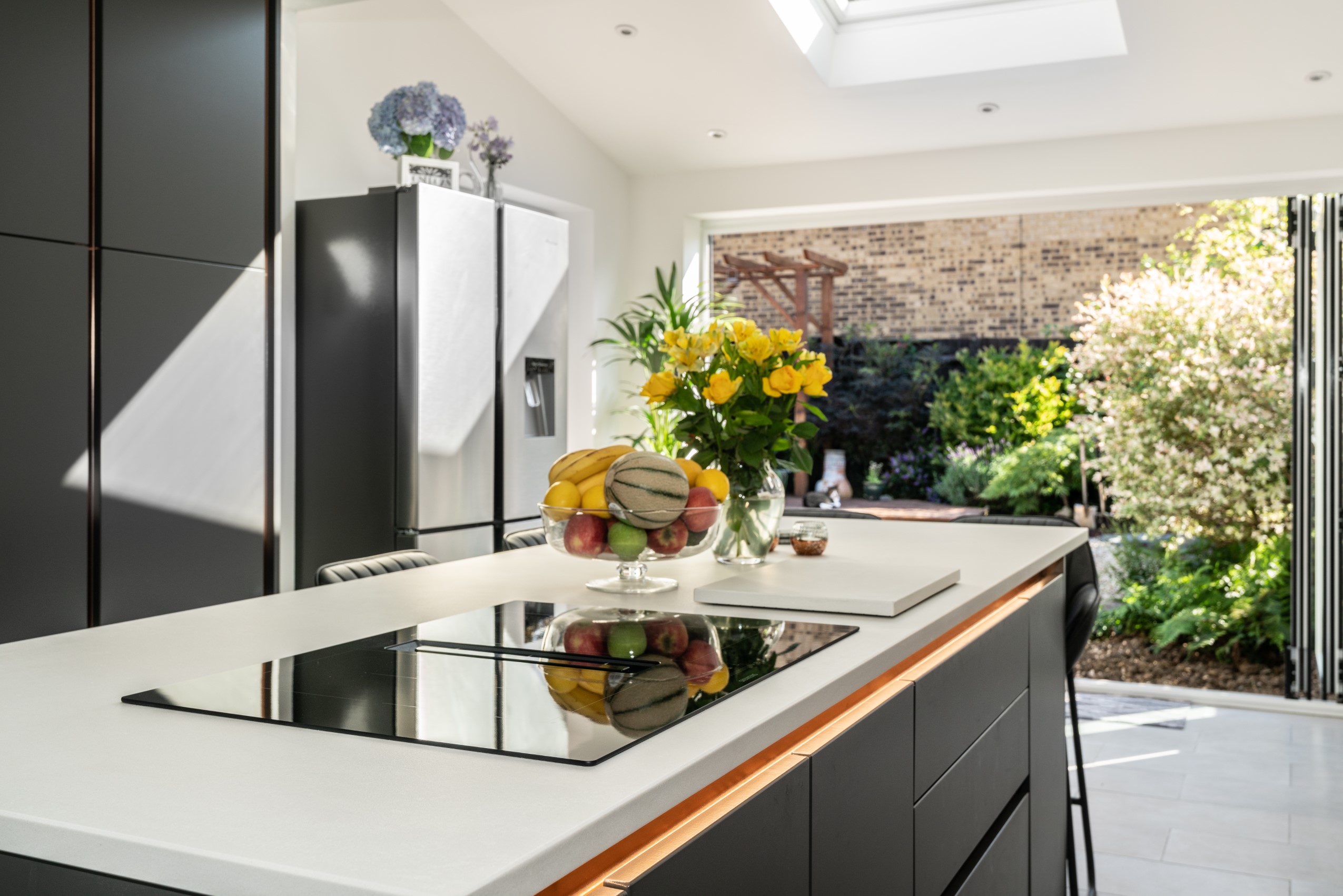
If there is one layer of lighting that makes the biggest difference to how a quartz worktop looks, it is under-cabinet lighting. It is still one of the most underused features in kitchen design. Strip LEDs mounted beneath wall cabinets cast light directly across the worktop surface at a low angle. This grazing light is exactly what veined quartz needs. Rather than flooding the surface from above, it skims across it, catching the edges of the veining and creating subtle highlights and shadows that bring the pattern to life.
When choosing the LEDs for under-cabinet lighting, colour temperature is critical. For most veined quartz surfaces, a warm white between 2700K and 3000K works beautifully. Cooler temperatures (4000K and above) can suit stark white and blue-grey surfaces, but they risk making warmer-toned veining look washed out or slightly green.
Equally important is the quality of the LED strip itself. Look for a Colour Rendering Index (CRI) of 90 or above. A high CRI ensures the LEDs reproduce colours accurately, so the subtle pigments in the veining read true rather than dull or grey under the light.

How to Use Pendant Lights Above a Quartz Island
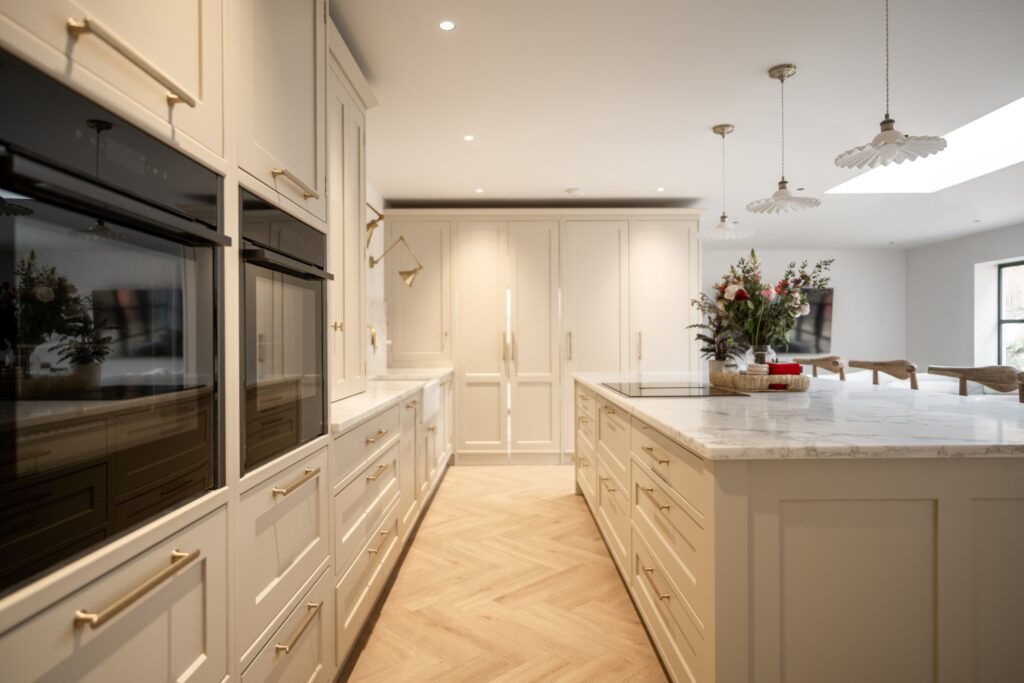
Pendant lights suspended above a kitchen island have become one of the defining features of modern kitchen design. Beyond their decorative value, they offer an opportunity to direct focused light onto the worktop surface below.
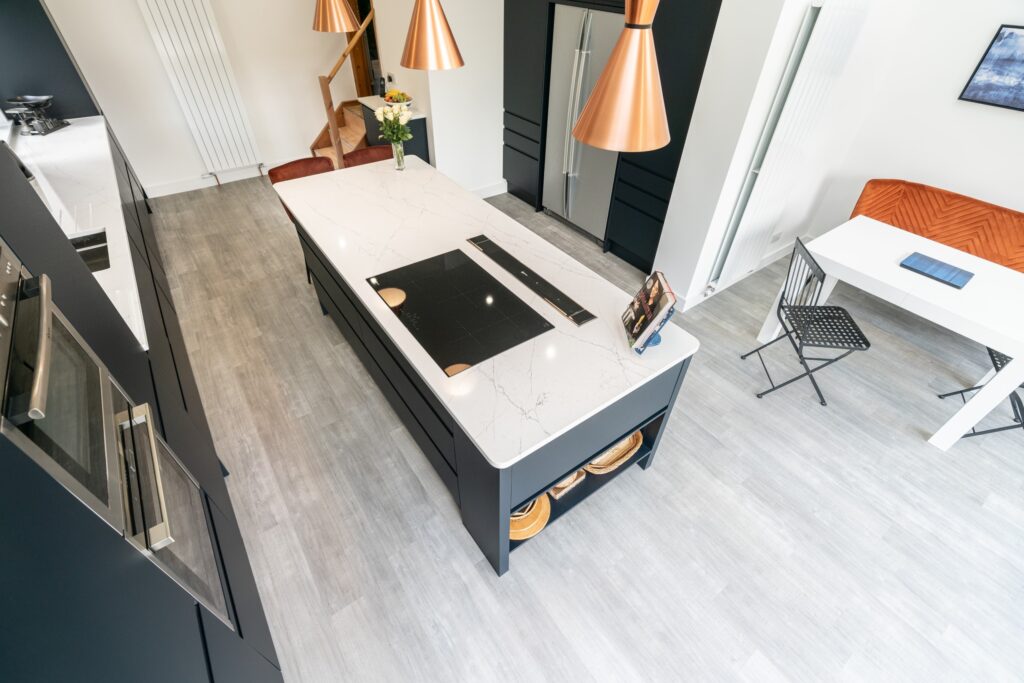
However, there is an important distinction to make. A single pendant hanging centrally over an island will create a pool of bright light directly beneath it. On a veined quartz island, this can work in your favour if the light has been positioned to catch the most dramatic section of the veining pattern.
Alternatively, a row of two or three pendants across the island distributes light more evenly and reveals the full veining pattern from end to end. This is the approach interior designers tend to favour for showpiece islands.
Whichever arrangement you choose, dimmable options give you the flexibility to adjust the mood throughout the day.

Do Recessed Downlights Work With Quartz Worktops?
The most common kitchen lighting is recessed ceiling downlights. The problem is that they sit directly above the worktop, which is the least flattering angle to show off veining. There are, however, ways to make downlights work in your favour:
- Make them adjustable so they can be angled, with the beam hitting the worktop at a slight angle
- Space them further back from the worktop edge, so the light grazes across the surface rather than landing directly from above
If you are planning a new kitchen, consider using downlights for general room illumination and relying on under-cabinet strips or pendants for the worktop itself. This layered approach gives you far more control and ensures the stone looks its best regardless of the time of day.
Polished or Matte Quartz: Which Suits Your Lighting?
The surface finish plays a significant role in how quartz responds to light, and therefore which lighting approach suits best.
- A polished finish is reflective. It bounces light back, creating bright highlights on the surface and emphasising the contrast between the veining and the base colour. Polished veined quartz looks spectacular under directed light sources.
- A matte finish absorbs more light and scatters it softly across the surface. The result is a more muted, understated look that feels contemporary and tactile. The veining will still be visible under overhead lighting, but it reads as part of the surface rather than sitting on top of it.
It is not about which one is better; it depends entirely on the look you want to achieve. This is why it is important to see the actual slab under different light conditions before you commit.

Lighting a veined quartz worktop, at a glance:
- Natural daylight from a side-on window reveals 3D depth (north-facing for cool greys, south or west-facing for warm beiges)
- Under-cabinet LEDs in warm white (2700-3000K) for most veined quartz, with CRI 90+ for true colour
- Pendant lights: 2-3 across an island for even reveal; a single pendant only when targeting a specific veining feature
- Recessed downlights: angle the beam, set them further back from the worktop edge
- Dimmable circuits give control over mood throughout the day
- Always view the slab in showroom lighting before committing
Frequently Asked Questions About Lighting Quartz Worktops
What is the best lighting for a veined quartz worktop?
The best approach is layered lighting. Natural daylight from a side-on window reveals depth in the veining, under-cabinet LED strips graze the surface to highlight detail, pendant lights spotlight an island, and angled recessed downlights provide background fill. Avoid relying on flat overhead lighting alone, as it washes out the veining pattern.
What colour temperature LED is best for quartz worktops?
Warm white between 2700K and 3000K suits most veined quartz, especially cream, beige and gold-toned surfaces. Cooler temperatures of 4000K or above can work for stark white and blue-grey quartz but risk making warmer veining look green or washed out. Always choose LED strips with a Colour Rendering Index (CRI) of 90 or higher to reproduce the stone’s pigments accurately.
How many pendant lights do I need above a quartz island?
For a typical kitchen island of 2 to 3 metres, two or three pendant lights spaced evenly across the length give the most flattering reveal of the veining from end to end. A single pendant centred over the island creates a strong pool of light and works only when you want to spotlight one dramatic section of the veining pattern.
Does polished or matte quartz work better with kitchen lighting?
Polished quartz reflects light and creates bright highlights, which emphasises the contrast between the veining and the base colour. It looks spectacular under directional lighting like pendants and under-cabinet LEDs. Matte quartz absorbs and scatters light for a softer, more contemporary look. The veining is still visible under overhead lighting but reads as part of the surface rather than sitting on top.
Do recessed downlights make quartz worktops look flat?
Yes, recessed downlights positioned directly above the worktop tend to wash out the veining because the light hits the surface from the least flattering angle. To improve this, use adjustable downlights angled to graze the surface, or position them further back from the worktop edge. Always combine downlights with under-cabinet lighting or pendants for the most flattering result.
Related blogs
How to Photograph Your Kitchen Worktop Like an Interior Designer
Are Quartz Worktops Durable Enough for a Busy Kitchen?
Living with Quartz Worktops: 7 Habits Every Owner Picks Up
40 Years in Stone: How Worktop Fabrication Has Changed Since 1986
The Reasons Why Quartz Will Still Be a Popular Kitchen Worktop in 2026
Why Calacatta Quartz is a Designer’s Favourite for High-End Homes
Cawdor Stone Gallery’s showroom is designed to let you see surfaces under varied lighting conditions to get the full effect. We carry an extensive range of veined quartz from brands such as Silestone, Caesarstone, Artemistone and many others, and we can show you how the different slabs respond to both natural and artificial light. More importantly, we can talk you through which surfaces will suit the specific lighting conditions in your kitchen.
With 40 years in the stone industry, we have seen how much difference the right lighting makes to the right surface. It is one of those details that separates a kitchen that looks good from one that genuinely stops you in your tracks.
Is it time to choose a worktop? We would love to help you get this right. Contact us today.
About Cawdor Stone Gallery. A family-run stone specialist with 40 years of experience supplying and fitting quartz, granite, marble, sintered stone and porcelain worktops across Hertfordshire, St Albans, Welwyn Garden City, Harpenden, Stevenage, Barnet and the surrounding areas. Visit our showroom to see full-size slabs in person under varied lighting.